
How to Store a Weed Eater Correctly
Improper storage is the most common cause of string trimmer starting and running problems at the beginning of the mowing season. A weed eater put away with untreated fuel in the tank and carburetor develops varnish deposits over winter that clog the carburetor’s tiny jets, resulting in a machine that cranks but will not start or runs only briefly before dying. The correct storage process takes less than 15 minutes and prevents this entirely.
Gas-Powered Weed Eaters: The Fuel Is the Key Issue
The overwhelming majority of gas-powered string trimmer problems following winter storage trace back to one cause: stale, gummed fuel left in the carburetor during the storage period. Gasoline degrades within 30 to 60 days without stabilizer treatment, leaving sticky varnish deposits that coat the carburetor bowl, clog the main jet, and seal the needle seat. The result is a trimmer that cranks freely but will not fire reliably on the following season’s first start.
There are two approaches to managing the fuel for storage.

Lucas Oil High Performance semi-synthetic 2-cycle motor oil is specially formulated for oil injection systems or premix ratios up to 50:1. Its advanced smokeless formula with low-ash additives helps deliver cleaner burning, reducing emissions and improving power. An ashless detergent inhibitor package helps minimize spark plug fouling and combustion deposits for cleaner exhaust ports and long trouble-free engine life.

Sea Dog Accu-Mix helps you accurately measure the correct oil-to-gas mixture for 2-cycle engines. The see-through bottle shows multiple mix ratios, including 24:1, 33:1, 40:1, 50:1, and 100:1, so you can measure in both liters and gallons. This reduces guesswork and helps ensure your crew mixes fuel correctly every time.

Pit Posse PP3318 is a racing utility measuring cup designed to mix 2-stroke oil and other engine fluids to accurate ratios. It features readable CC and ounce marks plus a 16:1 to 70:1 premix scale to remove guesswork and help you add the right amount quickly. A durable polyurethane jug with a debris-preventing cap and spill-resistant lid helps keep mixtures clean and easier to stir or shake for an even blend.
Approach 1: Empty the Fuel System (Preferred)
- Run the trimmer until it exhausts all the fuel and stops from fuel starvation
- Restart and allow it to run briefly on the residual fuel until it stops again
- Pull the starter cord 2 to 3 times with the choke open to clear the carburetor of remaining fuel
- The carburetor is now dry with no fuel residue to gum during storage
This is the preferred method because it leaves nothing behind that can degrade. The downside is that starting a fresh tank next season takes slightly longer on the first pull as the fuel system primes.
Approach 2: Treat the Fuel and Store Full
- Add a fuel stabilizer (Sta-Bil, Sea Foam, or equivalent) to the remaining fuel in the tank following the stabilizer’s dosing instructions
- Run the trimmer for 5 to 10 minutes to circulate the stabilized fuel through the entire fuel system including the carburetor
- Store with the full, stabilized tank
Stabilized fuel remains usable for 12 to 24 months. The advantage of this approach is that the trimmer starts on the first or second pull the following season without needing to prime the fuel system. The disadvantage is that even stabilized fuel eventually degrades, and any stabilizer failure during a very long storage period produces the same gumming problem.
Cleaning Before Storage
Clean the exterior. Wipe down the trimmer housing, guard, and head with a damp cloth. Grass sap and debris that has baked onto warm surfaces during use can become difficult to remove if left on through a long storage period.
Clean the trimmer head. Remove the trimmer head cover and clean any accumulated grass and debris from inside the head. Check the spool for line tangles and any cracking in the spool that would require replacement before next season. Rewind or replace the line if it is running low.
Inspect the air filter. For gas trimmers, remove the air filter and inspect it. A heavily clogged foam or paper filter should be cleaned or replaced before storage so the machine is ready to use at the start of next season without a service visit.
Fuel Mixture Reminder for 2-Stroke Engines
Most gas-powered string trimmers use 2-stroke engines that require a specific oil-to-fuel mixture ratio. Common ratios are 50:1 (2.6 ounces of 2-stroke oil per gallon of fuel) or 40:1 (3.2 ounces per gallon). The correct ratio for your specific trimmer is in the owner’s manual and on a label on the trimmer itself.
Never store or run a 2-stroke trimmer on unmixed gasoline; running without oil causes rapid engine seizure.
For pre-mixed fuel stored in a can, check the age of the mix. Pre-mixed 2-stroke fuel in a sealed container typically has a shelf life of about 30 days after opening, or up to 2 years in a properly sealed container if stabilizer was added at mixing time. If the stored mix is more than a month old and was not stabilized, replace it with fresh mix rather than storing the trimmer on degraded fuel.

Husqvarna XP+ 2-stroke oil is engineered to maximize performance in all Husqvarna 2-stroke engines. It’s JASO-FD certified with a low-smoke, low operating temperature formulation to help maintain engine protection. The semi-synthetic blend includes fuel stabilizer for improved consistency during use and storage.
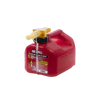
The NO-SPILL 2-1/2 gal Gas Can makes fueling cleaner and more controlled with a thumb button that starts and stops flow instantly. A 7/8-inch funnel spout with an attached dust cover helps fill small equipment while keeping the spout clean. The integrated 20 mesh stainless steel screen and auto-stop feature cut off fuel before overflow to reduce mess and accidental spills.
Storage Location
Store the trimmer in a dry location protected from extreme temperatures. Garages, sheds, and utility rooms all work well. Avoid storing outdoors uncovered, as UV exposure degrades plastic housing components and direct weather exposure promotes corrosion on metal parts.
For trimmers with removable batteries (battery-powered models), store the battery separately at room temperature and at approximately 50% charge. Storing a lithium-ion battery at 100% charge or near 0% charge for an extended period reduces the battery’s long-term capacity.
Quick Storage Checklist
Before putting the trimmer away for the season:
- Empty fuel system completely, or treat with stabilizer and run to circulate
- Clean the exterior and head
- Inspect and clean or replace the air filter (gas trimmers)
- Check the trimmer line and rewind or replace if needed
- Store in a dry, covered location
- Remove and store battery separately if battery-powered (50% charge, room temperature)
Related Guides
For the full lawn mower seasonal storage process, see lawn mower maintenance: a seasonal checklist. For guidance on fuel types, ethanol content, and stabilizer selection for all gas-powered outdoor equipment, see lawn mower fuel and oil guide: types, ratios, and mixing.