
How to Winterize Outdoor Power Tools for Storage
Winterizing outdoor power tools is the end-of-season maintenance step that has the greatest impact on how reliably those tools start and run the following spring. The most common reason a lawn mower, string trimmer, or leaf blower fails to start in April is degraded fuel left in the carburetor and fuel system over a winter of storage. Gasoline begins to oxidize and form gum and varnish deposits within 30 days under typical storage conditions, and those deposits restrict the small fuel passages in carburetor jets and needle valves. A 20-minute winterization routine in late fall eliminates most of the carburetor problems that would otherwise require a cleaning procedure before the first mow of spring.
The steps below apply to gas-powered outdoor power tools including four-stroke walk-behind and riding lawn mowers, two-stroke string trimmers, two-stroke backpack and handheld leaf blowers, and four-stroke tillers and cultivators. Battery-powered tools have a simplified winterization process covered at the end.
Step 1: Handle the Fuel System First
The fuel system is the most important part of winterization and should be done before any other step, because it requires running the engine briefly and the engine needs to be in running condition to do it.
There are two approaches: drain the fuel system completely, or add a fuel stabilizer to the tank and run the engine to distribute it through the carburetor.
Draining: Run the engine until it stops from fuel starvation, then use a hand siphon to remove any remaining fuel from the tank. Remove the fuel bowl from the carburetor if it has one and drain any pooled fuel. Leave the petcock or fuel shutoff closed. This is the most reliable approach for storage periods exceeding three months.
Stabilizing: Fill the tank with fresh gasoline if it is more than half empty, add the correct dose of fuel stabilizer per the product label instructions (the STA-BIL vs Sea Foam guide covers the dosage and application difference between the two), and run the engine for five minutes to draw treated fuel through the carburetor. This is adequate for storage of 30 to 90 days and avoids the need to source fresh fuel at spring startup.
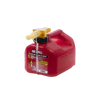
The NO-SPILL 2-1/2 gal Gas Can makes fueling cleaner and more controlled with a thumb button that starts and stops flow instantly. A 7/8-inch funnel spout with an attached dust cover helps fill small equipment while keeping the spout clean. The integrated 20 mesh stainless steel screen and auto-stop feature cut off fuel before overflow to reduce mess and accidental spills.

Sea Dog Accu-Mix helps you accurately measure the correct oil-to-gas mixture for 2-cycle engines. The see-through bottle shows multiple mix ratios, including 24:1, 33:1, 40:1, 50:1, and 100:1, so you can measure in both liters and gallons. This reduces guesswork and helps ensure your crew mixes fuel correctly every time.

Lucas Oil High Performance semi-synthetic 2-cycle motor oil is specially formulated for oil injection systems or premix ratios up to 50:1. Its advanced smokeless formula with low-ash additives helps deliver cleaner burning, reducing emissions and improving power. An ashless detergent inhibitor package helps minimize spark plug fouling and combustion deposits for cleaner exhaust ports and long trouble-free engine life.
Step 2: Fog the Cylinder
Fogging protects the cylinder wall and piston rings from surface corrosion during storage. Remove the spark plug from the engine. Spray a two-second burst of engine fogging oil or storage oil into the cylinder through the spark plug hole. Pull the recoil starter handle two or three times slowly to distribute the oil across the cylinder wall without starting the engine (there is no fuel in the system at this point). Leave the spark plug out for now.
Step 3: Inspect and Replace the Spark Plug
While the spark plug is already out for the fogging step, inspect it before deciding whether to reinstall it or replace it. Look for heavy carbon deposits on the electrode and ceramic, corrosion on the metal shell, or a visibly eroded center electrode. A plug in that condition will be a starting problem in spring. Replacement plugs for residential small engines cost $3 to $8. Use a feeler gauge or spark plug gap tool to confirm the electrode gap matches the specification in the owner’s manual before installing a new plug. Reinstall the plug and torque to the specification, or snug it firmly by hand if a torque wrench is not available.

Pit Posse PP3318 is a racing utility measuring cup designed to mix 2-stroke oil and other engine fluids to accurate ratios. It features readable CC and ounce marks plus a...
Step 4: Clean or Replace the Air Filter
Paper air filters cannot be washed, but they can be tapped lightly against a hard surface to dislodge loose debris and inspected against a bright light to check for tears, holes, or heavy loading that blocks airflow. A filter that is solidly grey-brown rather than its original off-white or cream color, or one that has visible damage, should be replaced before storage so it is ready for spring startup. Foam pre-filters can be removed, washed with dish soap and warm water, rinsed, allowed to dry completely, and lightly oiled with SAE 30 motor oil before reinstalling. Do not reinstall a foam pre-filter that is still damp.
Step 5: Clean the Tool Thoroughly
Grass clippings and soil hold moisture against metal surfaces during storage and accelerate rust on the deck, blade, and frame. Scrape the underside of the mower deck clean with a plastic scraper, paying attention to the corners around the blade mounting hub. Use a stiff bristle brush to clean the cooling fins on top of the engine and around the air intake. Wipe down the exterior of the machine with a dry cloth. Compressed air is useful for clearing debris from tight areas around the engine and frame. Do not use a pressure washer on the engine, air filter housing, or any switch or wiring components.
Step 6: Change the Oil If Due (Four-Stroke Engines)
Four-stroke mower and tiller engines should have an oil change at the end of the season if the interval has been reached or if the oil is dark and degraded. Running the engine for a few minutes before draining warms the oil so it flows out of the sump more completely. Remove the drain plug or tip the mower with the air filter up to drain through the fill tube, depending on the design. Fill with fresh oil to the full mark on the dipstick. Correct oil grade and capacity are in the owner’s manual. The SAE 30 vs 10W-30 guide covers which grade applies to different mower engines and operating temperatures.
Step 7: Store Correctly
A gas-powered outdoor tool stores well in any dry, covered space where temperature stays above freezing and ventilation is adequate. A detached garage or garden shed is ideal. Storing a tool with fuel remaining in the tank in an enclosed attached garage with living space above creates a fuel vapor accumulation risk over a long winter. If indoor storage with some fuel remaining is unavoidable, the tank should be sealed tightly and the storage space ventilated.
Winterizing Battery-Powered Tools
Battery-powered mowers, trimmers, and blowers do not require fuel system winterization. Remove the battery from the tool and store it separately. Lithium-ion batteries store best at approximately 40 to 80 percent charge in a dry location where temperature stays above freezing but does not exceed 85 to 90 degrees Fahrenheit. Do not store a lithium-ion battery at full charge or fully depleted over a long storage period, as either extreme accelerates capacity degradation over the battery’s lifetime. Clean the tool body and blade or cutting head as described above before storing.
The Full Maintenance Schedule
Winterization addresses the fuel system and seasonal storage preparation. The full annual service schedule for a gas mower, including blade sharpening, belt inspection, and carburetor service intervals, is covered in the lawn mower maintenance guide.