
Best Insecticidal Soap for Garden Pests
Insecticidal soap is the most contact-specific organic pest control product available to homeowners: it kills soft-bodied insects and mites on contact with no residual activity and no carryover risk to beneficial insects after the spray has dried. It is a reliable, safe tool when used correctly, but product quality varies considerably. Household dish soap marketed as a DIY alternative can cause phytotoxicity (leaf burn) on sensitive plants, and concentrations matter. This guide explains what distinguishes a properly formulated insecticidal soap from a household soap substitute, and which products deliver the best results for homeowners.
Why Formulated Insecticidal Soap Is Better Than Dish Soap
The key difference is the specific potassium salt of fatty acid formulation used in registered insecticidal soaps. Commercial insecticidal soap products are EPA registered at specific active ingredient concentrations and have been evaluated for efficacy and phytotoxicity across a broad range of plant species. The formulation also includes additives that improve spray coverage and adhesion to leaf surfaces without the surfactant compounds found in dish soaps that can cause phytotoxicity.
Household dish soaps contain detergents, fragrances, degreasing agents, and other compounds not present in pure potassium fatty acid soap. These compounds can strip the waxy cuticle from plant leaves, causing burning and yellowing, particularly on young growth, sensitive species, or plants under moisture or heat stress. If insecticidal soap is going to be applied more than once, a registered product is worth the small additional cost over a DIY dish soap solution.
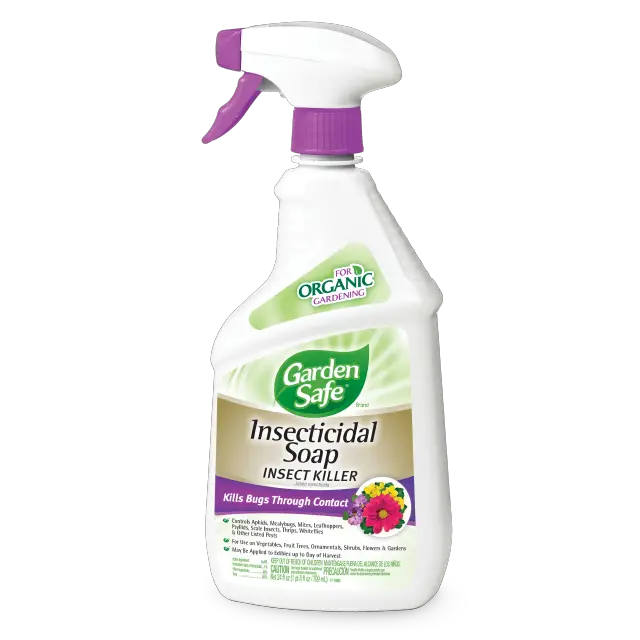
Garden Safe insecticidal soap is a ready-to-use contact spray that kills listed garden pests when sprayed directly on them. It’s formulated for organic gardening and can be used on vegetables, fruit trees, ornamentals, shrubs, flowers, and in indoor, outdoor, and greenhouse applications. For convenience, it may be applied to edibles up to and including the day of harvest.
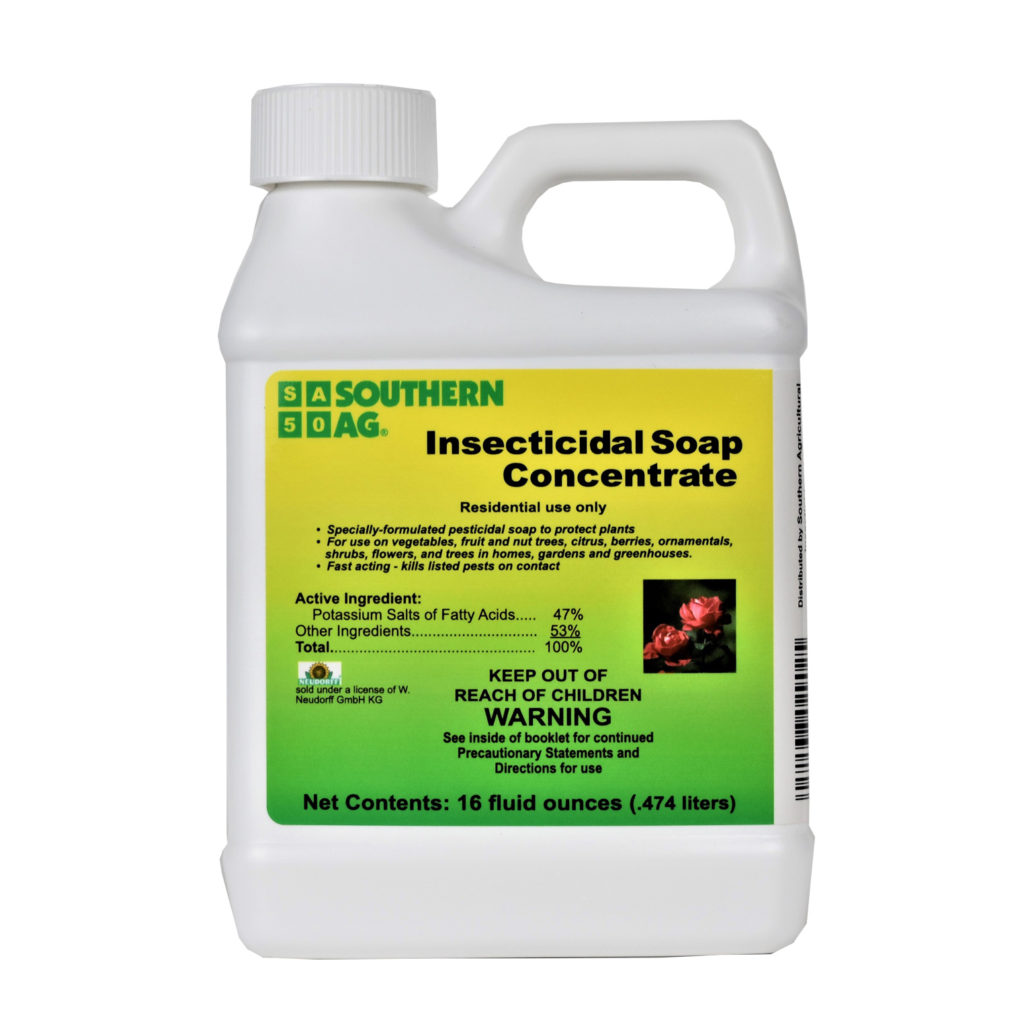
Southern Ag Insecticidal Soap Concentrate is a specially formulated pesticidal soap that delivers fast contact control of insect and mite pests. It’s suitable for use on vegetables, fruit and nut trees, citrus, berries, ornamentals, shrubs, flowers, and trees, including greenhouse and garden applications. Mix 4 teaspoons per quart of water and thoroughly spray all plant parts, including undersides of leaves.
What to Look for in an Insecticidal Soap Product
Active ingredient specification: Look for potassium salts of fatty acids as the listed active ingredient, with a concentration in the range of 1% to 2% in ready-to-use products and around 49% in concentrates.
OMRI listing or EPA registration confirms the product has been reviewed for organic compliance or pesticidal efficacy claims.
No added surfactants or adjuvants beyond what is necessary for emulsification. Cleaner formulations with fewer additives carry lower phytotoxicity risk.
Concentrate versus ready-to-use format is a practical decision: concentrates are more economical for homeowners treating multiple plants or making repeated applications through the season. Ready-to-use products are convenient for occasional spot treatments and eliminate the risk of over-concentration when mixing.
Top Products for Homeowners
Safer Brand Insect Killing Soap Concentrate
Safer Brand’s insecticidal soap concentrate is one of the most consistently available and well-regarded products in this category. The active ingredient is potassium salts of fatty acids at 49.52% concentration, which dilutes to roughly a 2% working solution according to label instructions. It is OMRI listed, EPA registered, and has been tested on a broad range of plant species including many sensitive ornamentals. The 16 oz concentrate makes approximately 6 gallons of working solution, which is economical for anyone managing pest pressure across multiple plants or a full garden bed. Effective against aphids, spider mites, mealybugs, scale crawlers, whiteflies, and thrips.
Bonide Insecticidal Soap Ready-to-Use
Bonide’s ready-to-use insecticidal soap spray is the most practical option for homeowners who need an immediately deployable product for spot treatments. The pre-mixed formulation means there is no concentration error risk, which is important on sensitive plants where over-concentration is the primary phytotoxicity risk. It comes in a trigger-spray bottle for targeted application. This format is less economical per unit of active ingredient than the Safer concentrate but is a practical fit for smaller gardens or houseplant collections where precise spot treatment is more important than volume coverage.
Garden Safe Insecticidal Soap Insect Killer Ready-to-Use
Garden Safe’s ready-to-use product is another well-formulated option widely available through mass-market garden centers. It shares a similar active ingredient profile with the Bonide product and performs comparably for most soft-bodied pest applications. The trigger spray format is suitable for foliage application on both indoor and outdoor plants.
Application Best Practices
Apply insecticidal soap in the early morning or evening when temperatures are below 90 degrees Fahrenheit and plant surfaces are not under heat or moisture stress. Direct midday sun during application significantly increases phytotoxicity risk on any plant species.
Ensure thorough coverage of all plant surfaces where pests are present, with particular attention to leaf undersides where aphids, whitefly nymphs, and spider mites concentrate. A light mist over the top of the plant treats only a fraction of the pest population. The spray needs to contact pests directly to kill them: once it dries, it is no longer active.
Reapply every three to five days for two to three treatment cycles to address pests that hatch from eggs after the initial application. Insecticidal soap has no ovicidal (egg-killing) activity, so a single application will not resolve an infestation where eggs are present.
Test on a small area of sensitive or unfamiliar plant species before treating the full plant, particularly on ornamentals that are not commonly listed on the product label.
For a detailed comparison of insecticidal soap versus neem oil and guidance on which to choose for specific pest scenarios, see our insecticidal soap vs neem oil guide.