
How to Get Rid of Mice and Rats in the House
Mice and rats are the most common rodent pests in North American homes, and the two species require similar but not identical control strategies because they differ in their behavior, range of movement, and the entry points they use. The house mouse (Mus musculus) is a small, curious rodent that explores new objects in its territory readily, making it relatively straightforward to trap. The Norway rat (Rattus norvegicus) and roof rat (Rattus rattus) are larger, more cautious, and neophobic, meaning new objects placed in their environment are avoided for several days before they approach. Both species contaminate food, damage insulation and wiring through gnawing, and carry disease pathogens in their droppings and urine, which makes timely control a health priority rather than a nuisance decision.
Signs of a Mouse or Rat Infestation
Droppings are the most consistent indicator of an active rodent infestation. Mouse droppings are 3 to 6 millimeters long, rod-shaped, and pointed at both ends. Rat droppings are larger, typically 12 to 20 millimeters for Norway rats, blunt-ended, and concentrated along their regular travel routes. Fresh droppings are dark and moist in appearance. Older droppings dry to a gray or crumbly texture. The volume and location of droppings indicate both the species present and the areas of heaviest activity.
Gnaw marks on food packaging, structural wood, wire insulation, and plumbing pipes are a secondary sign. Rodents gnaw constantly to maintain incisor length, and the size of gnaw marks helps confirm the species: mouse gnaw marks are small and irregular, while rat gnaw marks are larger and rougher. Runways, the smooth, grease-stained tracks that rodents leave along walls and baseboards from repeated travel along established routes, are most visible in dusty or lightly soiled areas. Nesting material, including shredded paper, insulation, and fabric, accumulated in concealed spaces such as wall voids, cabinet corners, and under appliances also confirms an active infestation.
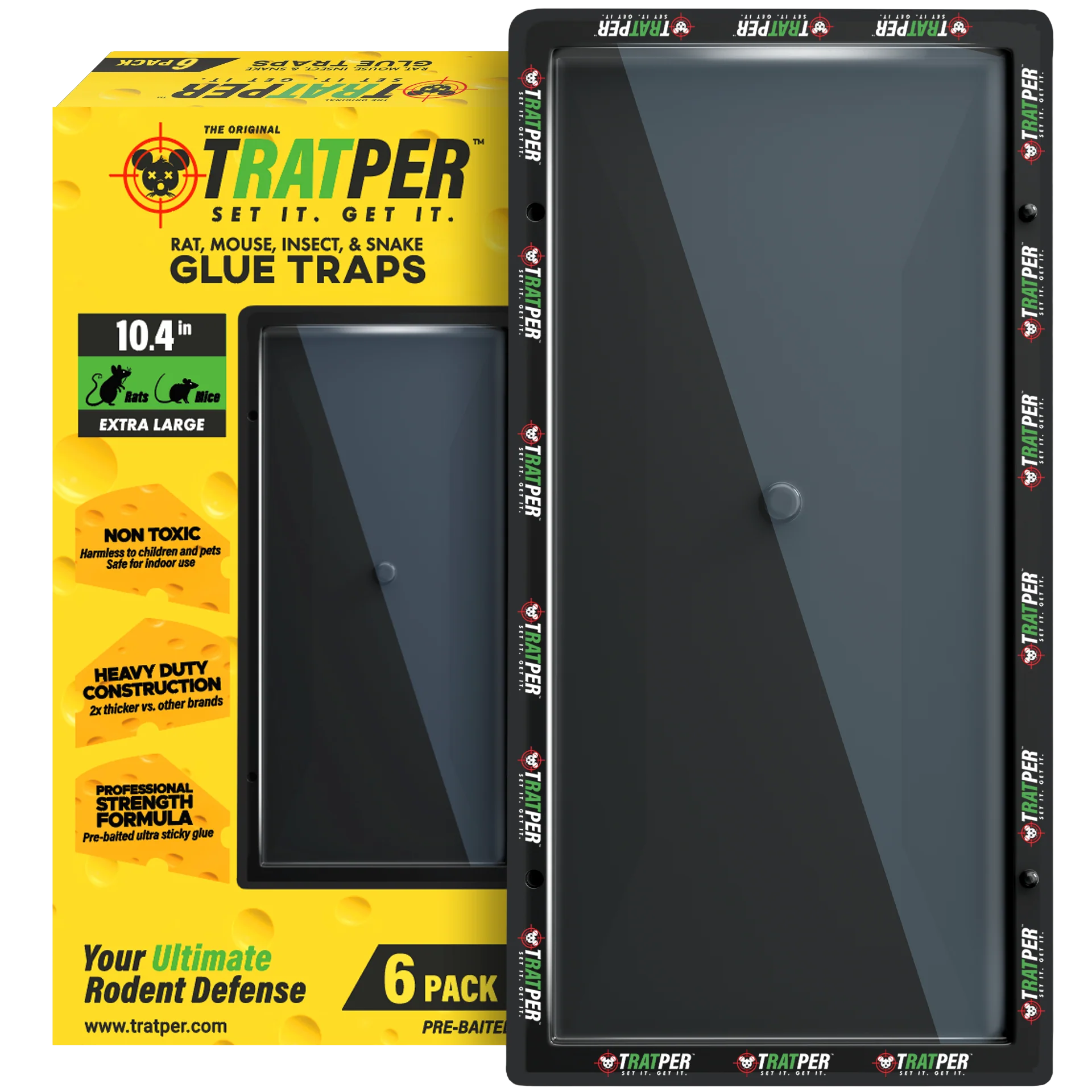
Tratper ready-to-use glue traps for mice, rats, and other pests come pre-baited with a peanut-butter scent so you can deploy them quickly. The extra-strength, high-tack...
How Mice and Rats Enter the Home
Mice can pass through any gap larger than 6 to 7 millimeters in diameter, approximately the size of a dime. Rats require a gap of around 12 to 20 millimeters for Norway rats and somewhat less for roof rats. Common entry points include gaps around pipe penetrations through exterior walls, the space beneath exterior doors with worn or missing door sweeps, cracks in the foundation, gaps in soffit panels and roof edges for roof rats, and unscreened vents. Identifying and sealing all entry points is the prerequisite to effective trapping because trapping without exclusion simply creates a vacancy that new rodents enter to fill.
Exclusion: Sealing Entry Points
Exclusion is the most durable long-term control strategy for rodents because it removes the access that allows reinfestation. Steel wool packed tightly into pipe penetrations and gaps, followed by a sealant such as caulk or expanding foam over the steel wool, blocks entry at those points. Copper mesh is an alternative to steel wool that does not rust. Hardware cloth with openings no larger than 6 millimeters installed over vents and openings provides permanent exclusion without blocking airflow. Door sweeps on all exterior doors should seal without a visible gap to the threshold.
Walk the full perimeter of the home at foundation level and inspect the roofline for roof rat access. Pay particular attention to the points where utility lines enter the building, the junction between the foundation and the siding, and any wood trim that shows signs of prior gnaw damage.
Trapping Mice and Rats
Trapping is the most effective and least risk-prone method of rodent removal for most homeowners, since it avoids the secondary poisoning and odor problems associated with rodenticide bait placed in wall voids where rodents may die inaccessibly. Snap traps are the standard and most cost-effective option for both mice and rats. For mice, standard snap traps are placed perpendicular to walls along active runways, with the trigger end facing the wall so the mouse encounters the bait as it travels along the baseboard. Multiple traps placed in pairs at each active location increase capture rates significantly.
For rats, larger snap traps designed for rat-scale rodents are required, and placement requires more patience. Because rats are neophobic, unset traps baited but not triggered should be placed along runways for three to five days before the traps are set. This acclimatizes the rats to the new object before the trap is armed. Bait options for both species include peanut butter, hazelnut spread, and nesting materials such as cotton. For product comparisons and the trap designs that perform best for each species, the options are covered in our best mouse trap and bait guide.
Using Rodenticide Bait Stations
Rodenticide bait stations are appropriate in situations where trapping is impractical, such as in outbuildings, crawl spaces, or along exterior perimeters. Tamper-resistant bait stations are the only format safe for use in homes with children or pets. First-generation anticoagulants such as diphacinone require multiple feedings to deliver a lethal dose and carry a lower risk of secondary poisoning compared to second-generation anticoagulants such as brodifacoum, which can accumulate in the tissues of raptors and predator mammals that consume poisoned rodents. For interior infestations, bait stations placed in enclosed spaces such as inside cabinet bases or behind appliances are safer than open-placement bait.
Rodenticide bait should never be used as the sole control method without exclusion in place, as it does not prevent new rodents from entering and creates the risk of rodents dying in wall voids and producing an odor problem.
Sanitation and Prevention
Rodents establish in homes where food, water, and shelter are accessible. Storing all dry goods in rigid sealed containers, eliminating standing water sources, and reducing clutter in storage areas removes the conditions that sustain an infestation. Firewood stored against the exterior of the home, overgrown vegetation along the foundation, and bird feeders within close proximity of the structure all provide harborage and food sources that attract rodents. Moving firewood at least 20 feet from the home and maintaining a clear zone at the foundation reduces harborage pressure significantly.
The broader framework for choosing between trapping, bait stations, and exclusion as parts of an integrated rodent management program is covered in our pest control methods guide.