
Best Mouse Trap and Bait for Indoor Use
Snap traps remain the most effective and cost-efficient tool for eliminating mice indoors, though the design and placement of the trap matters as much as the trap itself. A high-quality snap trap with a sensitive trigger, correctly positioned along an active runway with the right bait, outperforms a glue board, electronic trap, or live trap in capture rate per placement. For the full identification and placement strategy, including how to locate active runways and entry points before setting traps, the preparation steps are covered in our mice and rat control guide. The product recommendations below cover the trap types and baits that perform best across the scenarios homeowners encounter most.
]ez-toc]
What Makes a Mouse Trap Effective
Trigger sensitivity and kill speed determine whether a snap trap catches mice reliably or is triggered without a catch, a problem called “bait stealing.” A trigger plate that requires too much force allows a mouse to remove bait without springing the trap. The best snap traps use a hair-trigger mechanism that fires on the slightest contact with the trigger plate. Kill speed determines humaneness: a trap that delivers immediate blunt force trauma to the cervical spine kills in milliseconds, while a poorly calibrated trap that strikes elsewhere causes slow death. Bait cup design also matters, as a recessed cup holds soft bait more securely than a flat trigger plate and prevents bait from being removed without contact.
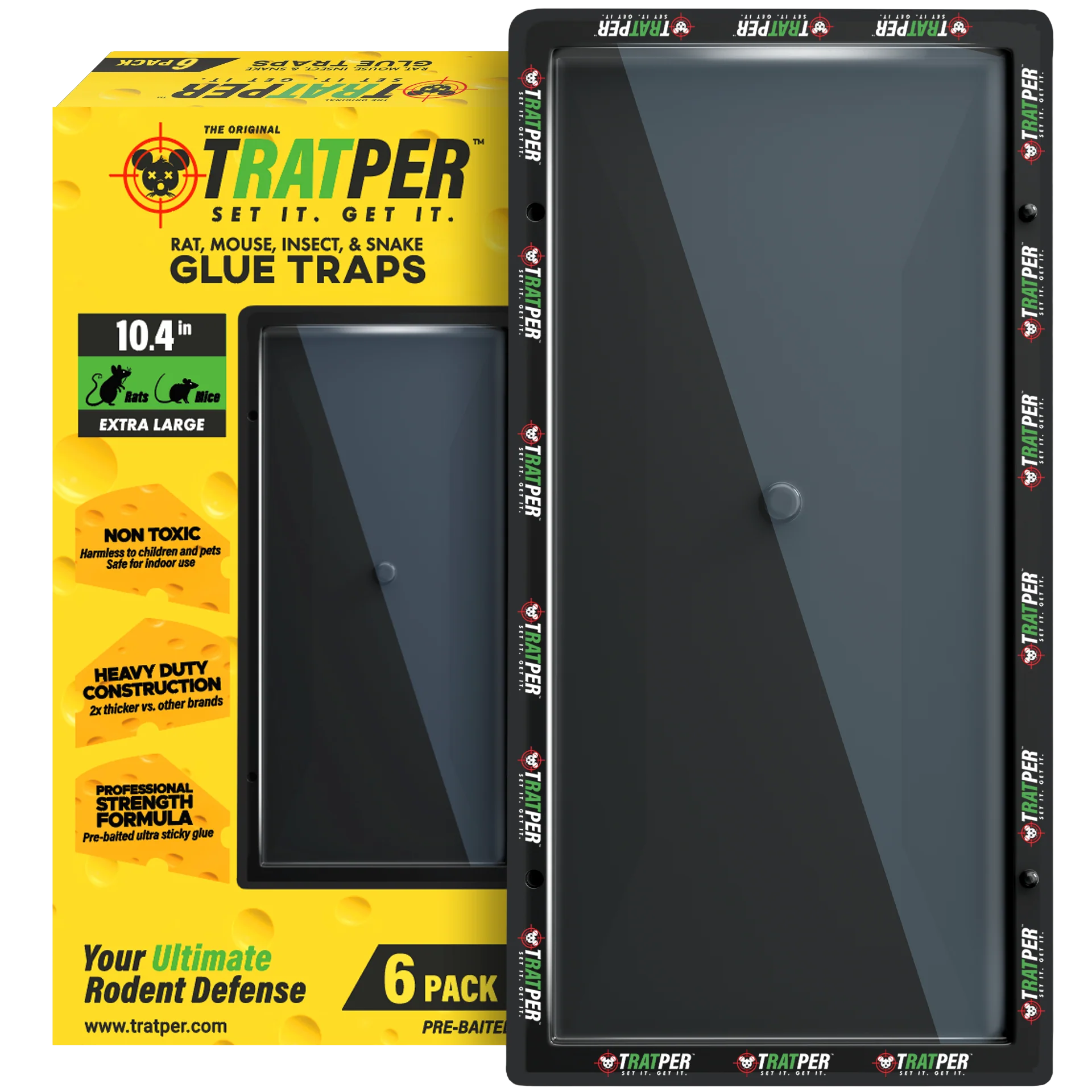
Tratper ready-to-use glue traps for mice, rats, and other pests come pre-baited with a peanut-butter scent so you can deploy them quickly. The extra-strength, high-tack...
Best Snap Trap for Mice: Victor M001 Original Mouse Trap
The Victor M001 is the original wood-and-wire snap trap design that remains the benchmark for mouse trapping performance. Its steel spring delivers reliable kill speed and the trigger mechanism is sensitive enough to capture mice that are feeding cautiously. The flat trigger plate accepts soft bait such as peanut butter applied directly to the plate surface. It is inexpensive enough to be used in the quantities needed for effective coverage, which typically means two traps placed side by side at each active location rather than a single trap.
Placement: Set traps perpendicular to the wall with the trigger end facing the wall surface. Place pairs at every location where droppings, gnaw marks, or runway grease stains indicate activity.
Best Plastic Snap Trap: Tomcat Press N Set Mouse Trap
The Tomcat Press N Set is a plastic snap trap with a hands-free set mechanism that makes arming and disposal significantly easier than a traditional wire snap trap. The trigger is sensitive, the kill bar clears the body of the trap consistently, and the closed design contains the catch. It is reusable and easy to clean between uses. For high-traffic placement points where frequent checking is practical, the Press N Set performs comparably to the Victor Original while being considerably easier to handle.
Placement: Same as the Victor Original. The closed body design makes it useful in areas where open wire traps are less appropriate, such as food preparation areas.
Best Multi-Catch Trap: Ketch-All Multiple Catch Mouse Trap
The Ketch-All is a wind-up mechanical live trap that captures multiple mice per setting without resetting, making it suitable for garages, attics, and other areas where checking individual snap traps frequently is impractical. The internal paddle mechanism spins when a mouse enters and deposits it into the catch compartment. It requires no bait, relying instead on the mouse’s natural curiosity about enclosed spaces.
Note on live traps: Caught mice must be released at least one mile from the home to prevent their return, and release in a populated area simply transfers the problem. Live trapping is a practical option where killing is not preferred, but it requires prompt checking to prevent deaths from stress or dehydration.
Best Electronic Trap: Victor M2524 Electronic Mouse Trap
The Victor M2524 delivers a high-voltage shock that kills mice in seconds and includes an indicator light that signals a catch without requiring the user to open the trap. It is the most humane kill option available in consumer formats and completely contains the dead mouse inside the chamber. The primary limitation is cost relative to snap traps, which means it is most practical as a supplemental trap for high-priority locations such as kitchen counters or pantry shelving rather than as the primary trapping method across an entire infestation.
Best Bait for Mouse Traps
Peanut butter is the most consistently effective mouse trap bait because its strong scent attracts mice at distance and its sticky texture makes it difficult to remove from a trigger plate without applying enough force to spring the trap. A pea-sized amount is sufficient. Hazelnut spread performs similarly. Nesting material such as a small piece of cotton or tissue paper tied to the trigger is effective for mice in nesting mode and does not become rancid in warm environments the way food baits can. Chocolate and soft cheese are secondary options that perform well in some situations but are less universally reliable than peanut butter.
Bait should be applied to the trigger plate or bait cup in the smallest effective amount. Excess bait allows mice to feed from the edges of the trigger without contacting the pressure point, resulting in bait theft without a catch.
How Many Traps to Set
The most common reason DIY mouse trapping fails is insufficient trap density. A single mouse travels along a relatively limited range of runways within a home, but a modest infestation of six to ten mice requires multiple traps at multiple locations operating simultaneously to reduce the population quickly enough to prevent breeding. A minimum of six snap traps for a small infestation, concentrated at the locations showing the highest activity, is a more effective starting point than two or three traps placed widely. Check and reset traps daily. Replace bait every two to three days in warm environments to maintain scent attractiveness.