
Gravel Grid Types: Plastic, Geocell, and Geogrid Compared
Three distinct product categories are sold under the gravel grid description, and they work in fundamentally different ways. Standard plastic honeycomb grids contain gravel at the surface, geocell systems provide deep structural confinement for heavy loads, and geogrid reinforces the base layer beneath aggregate rather than containing it at the surface. Choosing the wrong type for your application is the most common gravel grid purchasing mistake, and understanding the difference upfront prevents a costly error.
Standard Plastic Honeycomb Grids
Standard plastic honeycomb grids are the product that most homeowners find when searching for a driveway grid or gravel stabiliser. They are shallow, flat panels – typically 20mm to 50mm in cell depth – made from UV-stabilised polypropylene, pressed or injection-moulded into a regular honeycomb or square-cell pattern. Each panel is approximately 0.5 to 1 square metre in area, with interlocking tabs or pins along the edges that connect adjacent panels into a continuous surface layer.
The cells are open at the top and bottom. Gravel is poured over the installed panels and settles into each cell, with individual stones contained by the cell walls and prevented from migrating sideways. The grid itself sits on a geotextile membrane over the sub-base, anchored in place by the weight of the filled gravel above and the interlocking connections between panels.
Load distribution in standard plastic grids occurs because vehicle tyres bear on multiple cells simultaneously, spreading point loads across a wider area than the tyre contact patch alone. This reduces the pressure on any single point of the sub-base and limits the downward displacement that causes rutting. The effectiveness of this load distribution depends heavily on the quality and compaction of the sub-base beneath – a grid over a soft or poorly prepared base will still deform.
Cell depth and load rating are the two most important specifications to check when comparing standard plastic grids. A 20mm cell depth is adequate for pedestrian pathways. A 30mm to 40mm cell depth provides sufficient gravel retention and load distribution for a residential driveway carrying passenger vehicles. A 50mm cell depth handles heavier loads and is appropriate where light commercial vehicles or loaded trailers are expected. Most UK domestic gravel grids fall in the 30mm to 40mm range.
UV stabilisation determines how long the panels will last when exposed to sunlight. Polypropylene degrades under prolonged UV exposure unless the raw material contains UV stabilising additives. Quality products from established suppliers will specify that their polypropylene is UV-stabilised to a rated lifespan, typically 20 to 25 years for residential use. Cheap panels with no UV stabilisation become brittle and crack within a few years.
Named brands in this category include TrueGrid, NidaGravel, Core Gravel Grid, EcoDeck, EasyPave, ACO, Vevor, and Ibran. These products vary significantly in cell depth, wall thickness, interlocking system design, and UV stabilisation quality. Detailed product comparisons and recommendations by use case are in our best gravel grids guide.
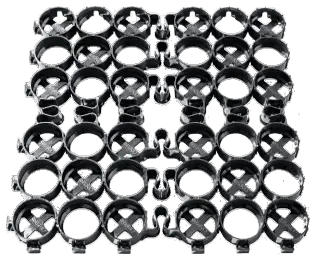
TRUEGRID PRO LITE permeable pavers are lightweight, DIY-friendly driveway and outdoor base pavers that install easily for a variety of projects. Made in the USA from 100%...
Geocell Systems
Geocell systems are deep, three-dimensional honeycomb structures made from HDPE (high-density polyethylene) strips welded together to form an expandable cellular network. Expanded and staked in place, each geocell panel creates a rigid series of deep cells – typically 75mm to 200mm or more – that can be filled with gravel, soil, concrete, or other aggregate materials.
The structural mechanism of geocell systems is fundamentally different from standard plastic grids. Where a standard grid contains gravel laterally and distributes vehicle loads across a wider surface area, a geocell system creates deep vertical confinement that dramatically increases the load-bearing capacity of the infill material. Gravel confined in a deep geocell cell behaves almost like a rigid block because the lateral restraint from the cell walls converts what would otherwise be a plastic, deformable aggregate mass into a structurally stable element. This mechanism is called confinement-induced stiffening, and it allows geocell-filled gravel to support loads that would cause an unconfined aggregate layer of the same depth to fail.
Applications for geocell systems extend well beyond residential driveways. Emergency access roads, commercial parking areas, slope stabilisation, load-bearing grass surfaces, and military logistics roads all use geocell technology. In residential settings, geocells are most commonly specified where standard plastic grids would be inadequate – heavy vehicle access, steeply sloped driveways where downslope migration is a concern, or applications requiring a reinforced grass surface rather than a gravel surface.
BaseCore Geocell is the most widely recognised brand in the residential geocell category in the US market, known for its recycled HDPE construction and good availability through online retail channels. Standard geocell manufacturers including PRS Geo-Technologies and Presto Geosystems supply products across a wider range of cell depths and panel sizes for more demanding applications.
Geogrid (Flat Mesh Reinforcement)
Geogrid is a flat, open-mesh panel made from high-tensile polyester, polypropylene, or fibreglass, used as a structural reinforcement material within aggregate base layers rather than as a containment layer at the surface. It is not a gravel containment product and will not prevent surface scatter or rut formation on its own. It is a base reinforcement product.
Installed horizontally within the aggregate base layer – typically at the interface between the subgrade soil and the crushed stone sub-base – geogrid works by creating a tensile reinforcement membrane that distributes load laterally across a wider area of the subgrade. When a vehicle passes over the surface, the weight is transmitted down through the sub-base and concentrated at the subgrade. Without reinforcement, soft or weak subgrade deforms under this concentrated load. Geogrid intercepts the shear forces that cause deformation and transfers them into tensile stress across the mesh, which the high-strength fibres resist effectively.
When geogrid is the right choice is determined by subgrade quality. If the ground beneath your installation is soft, waterlogged, or has poor bearing capacity – heavy clay, made ground, or ground that springs when walked on – geogrid in the base layer can rehabilitate the bearing capacity sufficiently to allow a stable sub-base to be built above it. Without geogrid in these conditions, the sub-base will pump and deform under traffic regardless of what is done to the surface.
Combining geogrid with a surface honeycomb grid is the correct approach for difficult ground conditions. Geogrid at depth addresses base instability. A standard plastic honeycomb grid at the surface addresses gravel containment. The two products target different failure modes and work independently of each other.
Which Type Do You Need?
For a standard residential driveway carrying passenger vehicles on stable, well-prepared ground: a standard plastic honeycomb grid in 30mm to 40mm cell depth is the correct product.
For a driveway carrying heavy vehicles, a steeply sloped surface, or ground with poor natural bearing capacity: a geocell system provides the structural performance that standard plastic grids cannot match.
For an installation on soft or weak ground where base stability is the primary problem: geogrid in the sub-base addresses the root cause, with a standard surface grid above it if gravel containment is also needed.
For a pathway or patio with foot traffic only: a lighter-duty standard plastic grid in 20mm to 30mm cell depth is sufficient and more economical.