
Gravel Grid for Paths and Walkways
Gravel grids are one of the most practical solutions for garden paths and walkways where loose gravel migration, uneven surfaces, and aggregate scatter onto adjacent planting beds are persistent problems. Pathway applications require lighter-duty grids than driveways, simpler sub-base preparation, and a different set of installation priorities that focus on edge containment, surface evenness, and aggregate stability underfoot rather than vehicle load distribution.
Why Gravel Grids Suit Pathway Applications
Loose gravel on a garden path moves underfoot because pedestrian loads, while much lighter than vehicle loads, still displace aggregate laterally with each step. Over a season of regular use, a path without containment develops bare patches at the centre where traffic is heaviest, and gravel accumulates at the edges and migrates into adjacent planting beds. Raking gravel back is a recurring chore that a grid largely eliminates.
A gravel grid on a pathway holds each stone within a cell, allowing the surface to flex slightly under foot traffic but preventing the lateral flow that creates bare patches and scatter. The surface remains even, the gravel stays within the path boundaries, and the aesthetic result is maintained without constant raking.
Grids also improve accessibility on gravel paths. Loose gravel is unstable underfoot for anyone using a walking aid, pushing a pram, or walking with young children. A gridded path with cells filled to just above the cell top presents a surface that gives slightly underfoot but does not shift unpredictably, making the path safer and more accessible for a wider range of users.
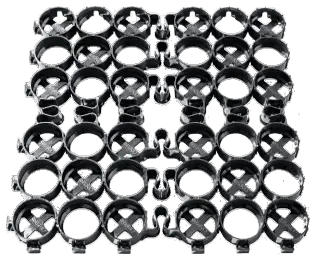
TRUEGRID PRO LITE permeable pavers are lightweight, DIY-friendly driveway and outdoor base pavers that install easily for a variety of projects. Made in the USA from 100%...
Pathway Grid Specification: How It Differs from Driveway Grids
Pathway applications do not require the cell depth or wall thickness needed for vehicle driveways. Pedestrian loads are several orders of magnitude lower than vehicle axle loads, which means the structural performance demands on the grid are correspondingly lower. This allows lighter, shallower products to be used, which reduces cost and simplifies installation.
Cell depth for pathways is adequate at 20mm to 30mm. A 20mm cell depth provides sufficient gravel retention for a pedestrian path with light to moderate use. A 30mm cell depth is appropriate for paths receiving heavier foot traffic, such as the main entrance path to a house or a path connecting a parking area to a building.
Gravel holder products for pathways – sometimes sold specifically under this description rather than as a driveway grid – are typically 20mm deep, made from lighter polypropylene, and sold in panel sizes suited to standard path widths of 600mm to 900mm. These pathway-specific products are generally better value for path applications than cutting down full driveway-rated panels to fit.
Sub-base depth for pathways is less demanding than for driveways. A 50mm to 75mm compacted layer of crushed stone over a geotextile membrane provides an adequate base for most residential paths. In areas with heavy clay soils or high water tables, additional drainage depth is worthwhile.
Edging Requirements for Gridded Paths
Edging at the path perimeter is essential regardless of whether a grid is used, but it is particularly important for gridded paths because the grid panels themselves need a restraint at the edges to prevent the outermost cells from splaying outward under lateral load. Without edge restraint, the grid can gradually open along the panel edges and gravel escapes through the gaps.
Edging options for gravel paths include pressure-treated timber boards set flush with the grid surface, metal lawn edging pinned into the ground alongside the grid perimeter, plastic landscape edging, and brick or natural stone set level with the path surface. The edging should be installed before the grid panels are placed, so that the panels can be butted up tight against the restraint.
Aggregate Selection for Pathway Grids
For pedestrian paths, the aggregate choice is broader than for driveways because aesthetic considerations carry more weight and the structural requirement is lower.
10mm to 14mm clean angular stone provides a firm, stable path surface that is easy to walk on and low-maintenance. It seats cleanly in 20mm to 30mm cells and drains well.
Pea gravel in 6mm to 10mm size is a popular choice for decorative garden paths because of its appearance and the pleasant sound underfoot. It is less stable than angular stone but performs adequately in a grid at pedestrian loads. Rounded pea gravel shifts slightly underfoot, giving the path a softer feel that some users find pleasant and others find slightly insecure.
Pathway Grids vs Driveway Grids: The Key Differences
| Specification | Pathway Grid | Driveway Grid |
|---|---|---|
| Typical cell depth | 20 – 30mm | 30 – 50mm |
| Load rating needed | Pedestrian only | 400+ t/m2 static |
| Sub-base depth | 50 – 75mm | 100 – 150mm |
| Edging criticality | High | High |
| Gravel size | 6 – 14mm | 10 – 20mm |
For homeowners who also need guidance on driveway grids and want to understand the specification differences, the full performance case and cost comparison for vehicle-rated grids is in our gravel grid for driveways guide.