
Gravel Grid for Driveways: Does It Work and Is It Worth It?
Gravel grids do work on driveways, and for homeowners who are willing to invest in correct installation they provide a genuine, measurable improvement over ungridded gravel. The honest qualification is that they work best for displacement control – reducing rut formation, scatter, and top-up frequency – and not as a substitute for a properly prepared sub-base. Understanding what grids deliver and what they do not changes whether the investment makes sense for your specific situation.
What Gravel Grids Actually Do on a Driveway
The problem that gravel grids solve on driveways is lateral displacement. Every time a vehicle tyre rolls onto loose gravel, the tyre contact patch pushes the stones sideways and downward. Over repeated passes the surface develops ruts at the wheel tracks and bare patches where gravel has migrated to the edges. Periodic regrading and top-up applications are the conventional maintenance response, but they address the symptom rather than the cause.
A gravel grid addresses the cause by giving each stone a cell to sit in. The cell walls resist lateral displacement under load, holding stones roughly in position rather than allowing them to flow away from the tyre contact area. The result is a surface that maintains its level and distribution significantly longer than ungridded gravel under the same traffic conditions.
Reduced rut formation is the primary benefit. Most homeowners with gridded gravel driveways report that wheel track ruts develop much more slowly than on previous ungridded surfaces, and in many cases do not develop meaningfully at all under normal passenger vehicle use.
Less scatter is the secondary benefit. Gravel that is contained within cells does not migrate as readily onto lawns, planting beds, and pathways alongside the driveway, reducing the time spent raking gravel back into the driveway surface.
Lower top-up frequency follows from both of the above. Because less gravel is displaced from the wheel tracks and less is scattered to the edges, the surface maintains its fill level for longer and requires less aggregate topping up over time.
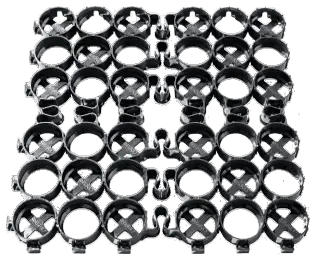
TRUEGRID PRO LITE permeable pavers are lightweight, DIY-friendly driveway and outdoor base pavers that install easily for a variety of projects. Made in the USA from 100%...
What Gravel Grids Do Not Do
Gravel grids do not improve a poor sub-base. If your driveway develops ruts because the ground beneath is soft, waterlogged, or inadequately compacted, a grid installed over that ground will still deform because the problem is structural rather than surface-level. A grid over a bad base is better than no grid over a bad base, but it does not solve the underlying problem. The sub-base specification needed beneath a gravel grid is the same as the sub-base needed beneath any gravel driveway, and the full specification is covered in our gravel grid installation guide.
Gravel grids do not eliminate the need for maintenance entirely. They extend the intervals between maintenance operations significantly, but they do not make a gravel driveway maintenance-free. Gravel will still need occasional topping up, weed management is still required, and the surface should be checked after severe weather.
Gravel Grid vs No Grid: Cost Comparison
The additional cost of a gravel grid installation over a standard ungridded gravel driveway comes from the grid panels themselves plus the additional geotextile membrane if not already specified. Panel costs vary by product and supplier, but a reasonable estimate for a quality residential driveway grid is $2 to $5 per square foot of installed area. For a 400 square foot driveway, grid panels alone add $800 to $2,000 to the project cost before installation labour.
The return on that investment comes from reduced maintenance: less frequent regrading, less gravel top-up, and less time spent managing scatter. For driveways that currently require regrading and topping up once or twice per year, the maintenance saving over a 10-year period will typically cover or exceed the grid installation cost. For driveways that currently perform well with minimal maintenance, the economic case for retrofitting a grid is less clear.
For homeowners already managing an existing gravel driveway and looking to reduce maintenance burden, the full maintenance strategy including regrading, weed control, and edge management is covered in our gravel driveway maintenance guide.
DIY vs Professional Installation
DIY installation of a gravel grid driveway is practical for most homeowners. The panels are lightweight, cut easily, and require no specialist equipment beyond a plate compactor for sub-base preparation. A standard domestic driveway can typically be completed over a weekend by two people working together. The step-by-step process, including sub-base preparation, geotextile placement, panel layout, and aggregate filling, is covered in detail in our how to install a gravel grid guide.
Professional installation adds labour cost but ensures correct sub-base preparation, which is the step most DIY installations get wrong. If sub-base preparation is the part of the process you are least confident about, getting a contractor to prepare the base and then completing the grid installation and gravel filling yourself is a reasonable middle-ground approach.
Pros and Cons of a Gravel Grid Driveway
The case for installing a gravel grid on a driveway rests on three genuine performance benefits: reduced rut formation, reduced scatter, and extended intervals between maintenance operations. For driveways that suffer visibly from displacement problems, these benefits are real and worthwhile.
The case against rests on the upfront cost, the requirement for correct sub-base preparation to realise the performance benefits, and the fact that grids do not eliminate maintenance entirely. For driveways on well-draining, stable ground that already perform acceptably, a grid is an improvement but not a transformation.
The honest summary: a gravel grid is worth installing if you are building a new driveway with a properly prepared base, or if you are managing an existing driveway that suffers from consistent rut and scatter problems. It is a lower priority if your existing driveway performs adequately with minimal maintenance.