
How to Get Rid of Spiders in the House
Most spiders found inside homes are entirely harmless to humans and are actively controlling the insects that would otherwise be more numerous in the same space. The common house spider (Parasteatoda tepidariorum), cellar spiders (Pholcidae), and the various hunting spiders that wander through the home are predators of flies, mosquitoes, moths, and other insects. Their webs in corners and along baseboards are the primary aesthetic objection rather than a genuine pest problem. The question of how to manage spiders in the home is therefore first a question of which species is present and whether any hazard exists, and only then a question of what to do about it.
Species That Warrant Attention
The two spider species in North America with medically significant venom that are encountered in residential settings are the black widow (Latrodectus species, primarily L. mactans in the east and L. hesperus in the west) and the brown recluse (Loxosceles reclusa, found primarily in the central and south-central United States).
Black widows are unmistakable: a glossy black abdomen with the characteristic red hourglass marking on the underside. They build irregular, strong cobwebs in low, sheltered locations: under outdoor furniture, in garage corners, inside wood piles, in crawl spaces, under decks, and occasionally in basement areas with outdoor access. They are not aggressive and do not enter living areas of homes readily, but their bites are medically significant and they should be treated with appropriate care in high-risk areas. A black widow found inside a garage, crawl space, or basement warrants removal or chemical treatment.
Brown recluses are light to medium brown with a violin-shaped marking on the dorsal cephalothorax (the fused head-body section). Their range is genuinely restricted to the central United States despite widespread internet misidentification: brown recluses are regularly reported in states far outside their actual range. If you are in the upper Midwest, Northeast, Pacific Northwest, or Canada, the spider you are looking at is almost certainly not a brown recluse. Within their actual range (Missouri, Kansas, Oklahoma, Arkansas, Tennessee, and adjacent states), brown recluses shelter in undisturbed areas including closets, storage areas, and basement corners where they hide inside boxes, behind stored materials, and in shoe storage.
For all other indoor spider species, including cellar spiders, house spiders, wolf spiders, and jumping spiders, no treatment beyond mechanical removal or exclusion is warranted unless the population density creates an unacceptable aesthetic or psychological burden.
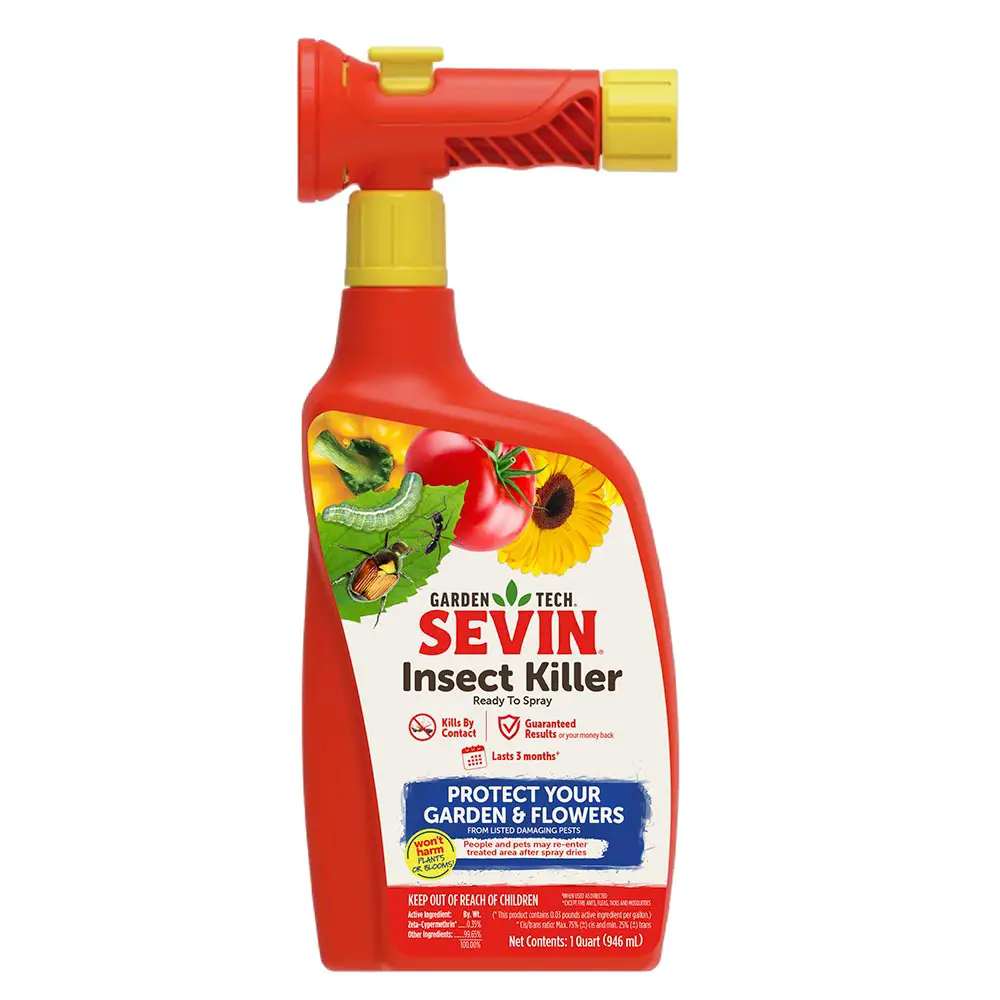
Sevin Insect Killer Ready to Spray helps protect flowers, vegetables, and ornamentals with a plant-safe formula that won’t harm blooms when used as directed. This...
Step 1: Remove Webs and Harborage
Regular web removal with a vacuum crevice tool or a broom along baseboards, ceiling corners, window frames, and behind furniture removes existing spiders and eggs and discourages reestablishment by eliminating the stable web sites that spiders maintain. Vacuuming is safer than swatting for black widows, as it reduces the chance of being bitten during direct contact.
Reduce indoor spider harborage by decluttering storage areas where undisturbed piles of boxes, fabric, and debris provide shelter: spiders are most concentrated in areas with the most undisturbed dark volume. Transfer stored items from cardboard boxes to sealed plastic bins, reduce clutter in basement and garage areas, and move firewood storage away from the home exterior to eliminate a major spider harborage site adjacent to entry points.
Step 2: Seal Entry Points
Spiders enter homes through the same gaps that allow other insects entry: gaps around window and door frames, utility penetrations, unscreened vents, and gaps in door thresholds. Sealing these entry points with caulk, expanding foam, and weatherstripping is the most durable reduction measure for the spiders that enter from outside.
Window screens in good repair with no tears or frame gaps prevent the crawling entry through windows that is particularly common for wolf spiders and jumping spiders in late summer and fall. Brush-style door sweeps on doors that seal against uneven thresholds close the large gap at the base of ill-fitting exterior doors that spiders readily traverse.
Step 3: Reduce the Prey Base
Spiders follow insects, and reducing the number of insects entering the home reduces the food base that sustains indoor spider populations. Switching exterior lighting near windows and entries from cool white or incandescent to warm white LED bulbs (2700K to 3000K) reduces insect congregation at those fixtures and the spider activity that follows. The relationship between light type and insect and spider activity is covered in our LED lights and spiders guide.
Chemical Treatment When Warranted
Residual insecticide spray applied to baseboards, window frames, door frames, and the interior wall-floor junction creates a contact-kill zone for spiders crossing treated surfaces. Products containing pyrethrin or deltamethrin at label-specified rates for indoor crack-and-crevice application are appropriate for this use. Apply to the surfaces spiders contact rather than attempting to spray them directly, as the residual surface treatment catches individuals moving through the home rather than requiring direct hit.
Insecticide dust (deltamethrin dust) applied into wall voids, crawl spaces, and other enclosed harborage areas provides longer residual activity than spray treatments in those environments and is the appropriate product for treating the enclosed areas where black widows and brown recluses shelter. Apply dust with a hand duster, directing it into cracks and voids rather than broadcasting it onto open surfaces.
Glue traps placed along baseboards in storage areas and garage corners serve both a capture function and a monitoring function, and are particularly useful in basement and garage environments where black widows may be present. Glue traps confirm species identity when spiders are caught and help locate the highest-activity zones for further treatment.