
How to Get Rid of Silverfish in Your Home
Silverfish (Lepisma saccharina) are one of the most ancient insect orders on earth, with a body plan essentially unchanged for over 400 million years, and their persistence as a household pest reflects a simple biological formula: high humidity plus dark harborage plus starchy food equals an established population. A silverfish treatment that does not address all three of those conditions will suppress the visible population temporarily while the colony rebuilds. The program that actually eliminates silverfish and keeps them out works across all three simultaneously.
Identifying Silverfish and Their Damage
Silverfish are 12 to 19 mm long, teardrop-shaped, covered in silvery-gray scales, and move with a distinctive wriggling, fish-like motion that gives them their common name. They are wingless, have three long tail filaments (two cerci and one central median appendage), and long antennae. As nocturnal insects, they are most often observed when disturbed from hiding during nighttime activity: scattering when a bathroom or kitchen cabinet light is turned on, or discovered behind loose baseboards and in undisturbed paper storage.
Silverfish damage appears as irregular feeding holes in paper, wallpaper, book pages and bindings, and natural-fiber fabric, with a characteristic surface-scraping pattern that removes the printed surface from photos and book covers without cutting through the page entirely. Yellow staining on paper and fabric from silverfish excrement is another indicator of active feeding. Shed exuviae (molted skins) found in dark cabinet corners and behind baseboards confirm the presence of an active population.
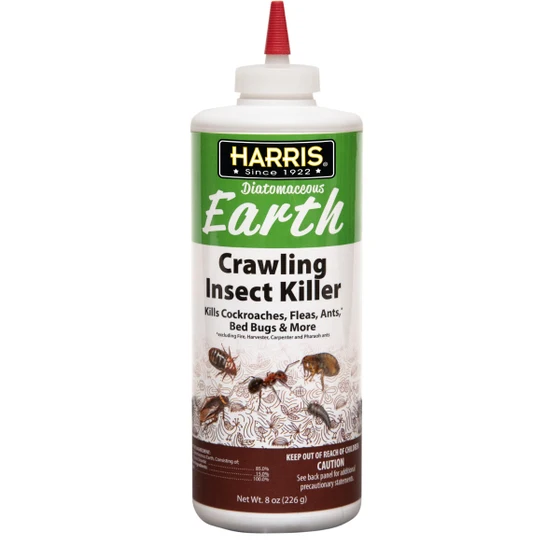
Harris Diatomaceous Earth Crawling Insect Killer is a ready-to-use 100% natural dust that targets crawling pests including ants, roaches, bed bugs, and fleas. Insects that contact or ingest the powder die within 48 hours when applied in cracks, crevices, and other hiding areas. Suitable for indoor and outdoor use with a powder duster included for easy application.
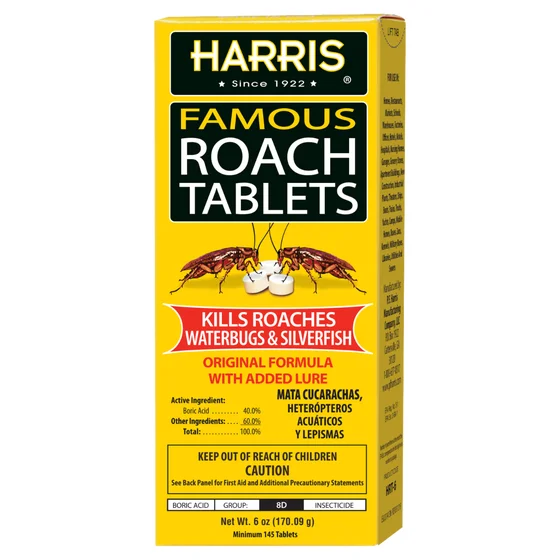
Harris Roach Tablets use boric acid with a formulated lure to attract roaches and help eliminate infestations at the source. The EPA-registered tablets are long lasting when kept dry and are designed to kill the entire colony by roaches carrying the bait back to their nests. Easy to conceal in hidden areas like under drawers, appliances, and cabinets, they offer an alternative to bait traps for treating multiple rooms.
Step 1: Reduce Humidity in Affected Areas
Silverfish cannot maintain a viable population in environments where relative humidity is consistently below approximately 50%. The humidity control step is the most durable long-term silverfish management tool because it addresses the fundamental environmental requirement the population depends on, rather than just killing the individuals present at the time of treatment.
In bathrooms, install or improve exhaust fan ventilation to reduce post-shower humidity, repair any slow drips or leaks under sinks or around toilet bases, and ensure that bath mats and towels dry completely between uses. In basements, a dehumidifier sized to the space and set to maintain humidity below 50% is the single most effective silverfish population control measure for below-grade spaces. Seal visible cracks in basement walls and floors that allow ground moisture to enter. In crawl spaces, a vapor barrier on the ground surface combined with adequate ventilation reduces humidity at the floor level that connects to the living space above.
Step 2: Remove and Protect Food Sources
Systematically removing or protecting the food sources that sustain the silverfish population eliminates their feeding base and accelerates population decline after humidity reduction begins.
Transfer dry goods including flour, cereal, rice, pasta, and crackers from their original cardboard or paper packaging into sealed glass or hard plastic containers with tight-fitting lids. Silverfish cannot penetrate sealed plastic or glass. Store pet food in sealed containers between meals.
For paper and book storage, move collections from open shelving in humid basement or bathroom areas to interior rooms or to sealed plastic storage bins. Silverfish do not penetrate sealed plastic storage, so archival materials and rarely accessed paper collections can be fully protected without any chemical treatment by simply moving them to a sealed container.
Remove cardboard box storage from basements and closets where silverfish activity is confirmed, as cardboard provides both food (the cellulose and adhesive) and harborage (dark, undisturbed interior structure).
Step 3: Apply Targeted Treatment to Harborage Zones
Once the humidity and food source steps are underway, targeted insecticide application to silverfish harborage zones accelerates the population reduction that environmental modification begins.
Diatomaceous earth applied as a thin, dry layer inside the gaps behind baseboards, in the cabinet gap at the floor line, and along wall-floor junctions in bathrooms and basements is a physical treatment that kills silverfish crossing the treated surface without any chemical active ingredient. It remains effective as long as it stays dry. Reapply after any moisture event. Food-grade diatomaceous earth is safe for use in areas accessible to children and pets when applied as a thin layer in out-of-reach crevices.
Pyrethrin or deltamethrin spray applied as a crack-and-crevice treatment to baseboards, cabinet interiors, and wall voids where silverfish are active provides residual kill of individuals crossing the treated surface. Apply the spray into cracks rather than as a broad surface spray, and avoid application on food-preparation surfaces or inside food storage areas.
Silverfish traps containing a glue-and-attractant matrix capture individuals moving through treated areas and provide a population monitoring function that helps confirm whether the population is declining in response to treatment. Traps placed along baseboards and in cabinet corners in known silverfish areas are useful both for direct capture and for confirming the effectiveness of the broader program over time.
Step 4: Seal Entry Points
Silverfish enter from outside through gaps in the building foundation, around plumbing penetrations, and through shared wall voids in multi-unit buildings. Caulking gaps around pipe penetrations under sinks, filling cracks in the basement wall, and applying weatherstripping to doors that seal against concrete or tile floors reduces the ongoing entry from outdoor populations in high-humidity exterior environments.
New silverfish entries from outside are most frequent in summer and fall, when outdoor temperatures and humidity create favorable conditions in the leaf litter and mulch adjacent to the foundation. Maintaining a mulch-free zone of six to twelve inches adjacent to the foundation and keeping exterior grade sloped away from the building reduces the exterior habitat adjacent to entry points.