
Common Lawn Fungal Diseases: Identification and Treatment
Lawn fungal diseases are caused by pathogenic fungi that colonize turf grass under specific environmental conditions, typically a combination of warm temperatures, high humidity, and prolonged leaf wetness. Each disease has a distinct visual signature and a preferred set of host grasses and environmental triggers, which makes accurate identification essential before applying any fungicide. Different fungal pathogens require different active ingredients, and applying the wrong product delivers no benefit.
Brown Patch (Rhizoctonia solani)
Brown patch is the most common and widespread fungal disease in residential lawns. It affects all common cool-season grasses but is most severe on tall fescue, perennial ryegrass, and Kentucky bluegrass. It can also affect warm-season grasses, particularly during periods of unusual cool-wet weather.
Visual identification. Brown patch produces roughly circular patches of tan to brown grass ranging from 6 inches to several feet in diameter. The edges of the patches may show a dark, water-soaked border (the “smoke ring”) in the early morning before dew evaporates, this border effect is one of the most reliable diagnostic signs for brown patch. The interior of the patch turns tan and dies, but in some cases the grass at the center of a large patch recovers, producing a ring or donut pattern.
Environmental triggers. Brown patch is most active when nighttime temperatures stay above 70°F, daytime temperatures are above 85°F, and relative humidity is high. These conditions are most common in the Southeast and Mid-Atlantic from June through August.
Conditions that favor it. Excessive nitrogen fertilization (particularly fast-release nitrogen) in late spring or summer promotes the lush, soft growth that is most susceptible to brown patch. Late-afternoon or evening irrigation that leaves grass blades wet overnight significantly increases infection risk.
Management. Water in the early morning so blades dry during the day. Avoid high nitrogen applications in summer. Improve air circulation by mowing at the correct height, do not allow the grass to become excessively dense and mat-forming. Apply a labeled fungicide when conditions favor disease development: propiconazole, azoxystrobin, and myclobutanil are all effective against Rhizoctonia. Apply preventively in high-risk periods for the best results, curative applications after large patches have formed are less effective.
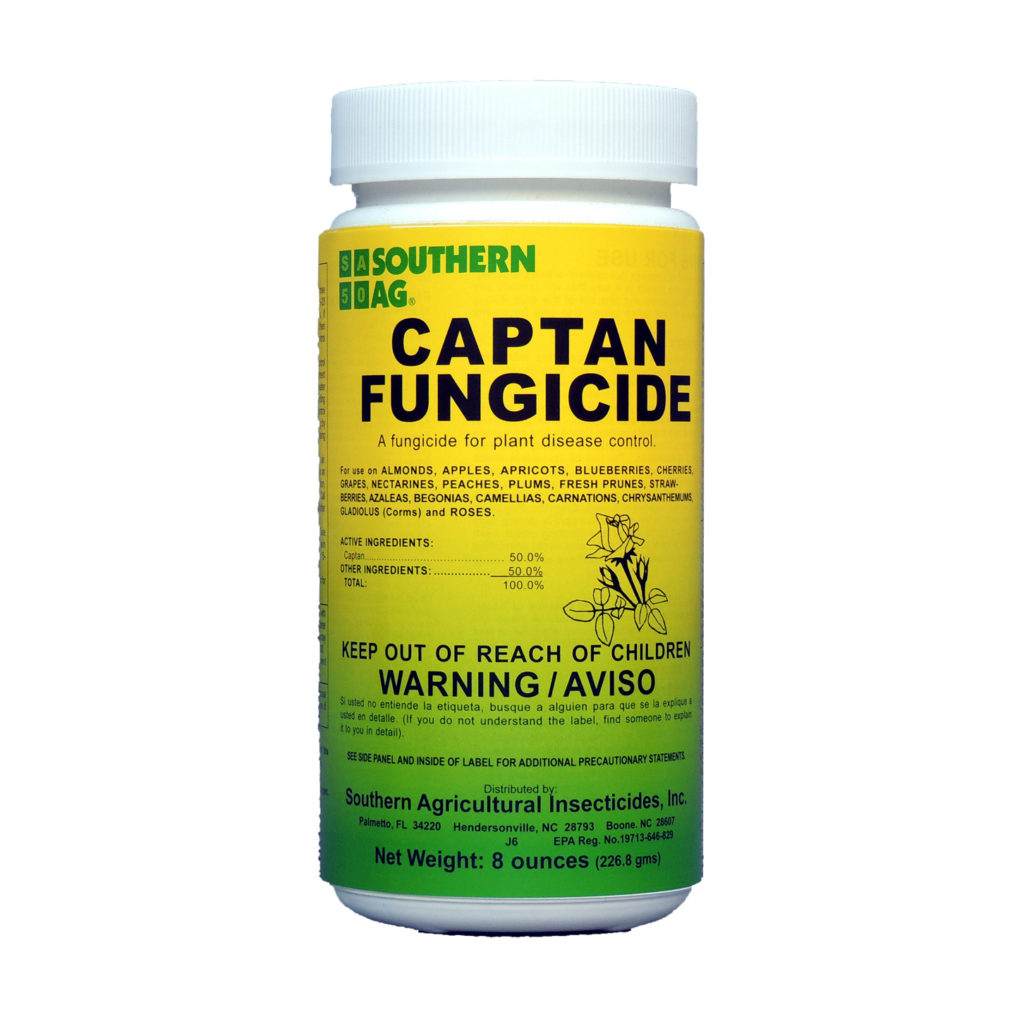
Southern Ag Captan Fungicide helps control Botrytis rot (grey mold) on strawberries and protects a wide range of fruit crops and ornamentals. It’s labeled for many fruits,...
Dollar Spot (Clarireedia jacksonii, formerly Sclerotinia homoeocarpa)
Dollar spot is a fungal disease that affects many turf grasses, with particular severity on bentgrass, Kentucky bluegrass, perennial ryegrass, and Bermuda grass at lower mowing heights. It is named for the roughly silver-dollar-sized spots it produces.
Visual identification. Dollar spot produces small, bleached, straw-colored spots 1 to 4 inches in diameter. In heavier infestations, individual spots coalesce into larger irregular dead areas. Individual grass blades show a distinctive hourglass-shaped lesion, a tan or bleached center band with reddish-brown borders on both sides of the blade. Mycelium is sometimes visible as a white cottony web on affected blades in the early morning.
Environmental triggers. Dollar spot is most active when temperatures range from 60°F to 85°F with alternating wet and dry periods. It frequently coincides with drought stress, lawns under mild water stress are more susceptible.
Conditions that favor it. Low nitrogen levels make grass more susceptible to dollar spot. Extended dew periods and poor air circulation also favor the disease.
Management. Maintain adequate nitrogen levels, dollar spot often responds to a light nitrogen application that boosts the grass’s own resistance. Water deeply and infrequently in the morning. Reduce thatch accumulation, which provides a reservoir for overwintering fungal structures. Fungicides effective against dollar spot include propiconazole, thiophanate-methyl, and myclobutanil.
Red Thread (Laetisaria fuciformis)
Red thread is a common disease in cool-season lawns during cool, moist weather. It is most prevalent on perennial ryegrass and fine fescues but also affects Kentucky bluegrass and tall fescue.
Visual identification. Red thread is identified by the distinctive pinkish-red or coral-colored thread-like structures (fungal sclerotia) that extend from the tips of infected grass blades and bind blades together. From a distance, the affected patches appear pink or tan. Patches are typically irregular in shape, ranging from a few inches to 1 to 2 feet in diameter.
Environmental triggers. Red thread is most active in cool, moist conditions, air temperatures between 40°F and 75°F with extended leaf wetness. It is common in spring and fall in cool-climate regions and during cool, wet summers.
Conditions that favor it. Low nitrogen and low potassium levels significantly increase susceptibility. Red thread is often an indicator of underfed turf.
Management. A light nitrogen application typically reduces red thread activity significantly within a few weeks. Improve drainage, reduce thatch, and ensure irrigation timing leaves blades dry during the day. Fungicide treatment is rarely necessary for red thread in residential lawns, nutrition management alone usually controls the disease.
Pythium Blight (Pythium aphanidermatum)
Pythium blight is a highly destructive disease that can kill large areas of turf very rapidly under the right conditions. It primarily affects perennial ryegrass, annual bluegrass, and tall fescue, and spreads rapidly through surface water movement.
Visual identification. In early morning, Pythium blight produces a distinctive cottony white mycelium across affected areas before the dew dries. Affected patches initially appear water-soaked and greasy, turning brown and collapsing rapidly, large areas can go from green to dead within 24 to 48 hours under severe infection pressure. Patches often develop in elongated or streaking patterns following drainage patterns or mower traffic that spreads the mycelium.
Environmental triggers. Pythium blight is strictly a hot, humid weather disease. It requires nighttime temperatures above 68°F and daytime temperatures above 86°F, combined with high humidity and free water (rain or irrigation) on the leaf surface.
Management. Avoid irrigation that leaves leaves wet overnight. Improve drainage. Do not apply excessive nitrogen in summer. Pythium blight moves quickly and requires a fungicide specifically effective against oomycete pathogens, mefenoxam (metalaxyl), fosetyl-Al, and propamocarb are effective against Pythium. Standard turf fungicides active against other diseases are not effective against Pythium.
Gray Leaf Spot (Pyricularia grisea)
Gray leaf spot primarily affects St. Augustine grass in the South and warm-season transition zones. It can also affect perennial ryegrass and tall fescue overseeded into warm-season lawns.
Visual identification. On St. Augustine, gray leaf spot produces small, brown, water-soaked spots on the blades with olive-gray centers and a distinct dark brown border. Under high disease pressure, the spots rapidly enlarge and coalesce, giving the entire lawn a scorched or burned appearance. On ryegrass, the spots are smaller with a gray center and tan margins.
Environmental triggers. High temperatures (above 80°F) combined with high humidity and frequent rain or irrigation. The disease is most severe during summer rainy seasons in the Gulf Coast and Southeast.
Management. Avoid applying nitrogen during periods of high disease pressure in summer, lush growth is far more susceptible. Water in the early morning and avoid evening irrigation. Azoxystrobin and pyraclostrobin are effective fungicides for gray leaf spot control.
General Principles for Fungal Disease Management
Accurate identification before applying any product is the most important step. If the visual identification above is inconclusive, contact your local county extension office, many provide disease diagnostic services for turf samples at low cost.
Cultural practices matter more than fungicide applications for most residential turf diseases. Watering in the early morning, mowing at the correct height, maintaining appropriate nitrogen levels without excess, reducing thatch, and improving air circulation through correct aeration all reduce the risk of fungal disease significantly before any chemical intervention is needed.
When fungicides are warranted, follow the product label rates exactly. Under-application does not control the disease effectively. Over-application increases cost and environmental load without additional benefit. Rotate between fungicide active ingredients with different modes of action when making repeat applications, applying the same active ingredient repeatedly increases the risk of developing resistant pathogen populations.