
Effect of Dish Soap on Lawns: Is It Safe?
Dish soap appears in DIY lawn care recommendations for several different purposes: as a carrier for homemade insecticide sprays, as a wetting agent to improve water infiltration on hydrophobic soil, and as a “grub flushing” agent to bring grubs to the surface for counting. Whether it is safe for lawn grass depends on the concentration used and the frequency of application.
What Dish Soap Actually Does to Grass
Dish soap is a surfactant, it reduces the surface tension of water, allowing it to spread across and penetrate surfaces more easily. At very low concentrations (1 to 2 teaspoons per gallon of water), dish soap does not damage grass and can be used as a mild wetting agent in a pinch.
At higher concentrations, dish soap strips the protective waxy cuticle from grass blades. The cuticle is the thin waxy layer on the outside of the blade that regulates water loss and provides some protection against environmental stress. Strip it away and the blade desiccates more rapidly, particularly in hot, dry conditions. Repeated applications at even moderate concentrations can thin the turf and reduce its stress tolerance.
Modern dish soaps also contain additional cleaning agents, fragrances, and additives that may contribute to soil salt load and affect soil biology at higher application rates. These effects are minimal at very low concentrations but accumulate with repeated use.
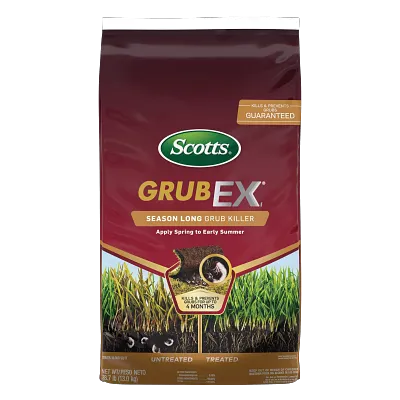
Scotts GrubEx1 is a season-long grub killer that keeps protecting your lawn from grubs and damage for up to 4 months with a single application. It helps stop grubs before...
When Dish Soap Is Safe to Use on Lawns
As a grub flushing agent. Mix 2 to 4 tablespoons of dish soap per gallon of water and apply to a 1-square-foot area to flush grubs to the surface for counting. This concentration is higher than ideal for repeated use but is safe for a single diagnostic application. Count the grubs that surface within 10 minutes. More than 5 per square foot indicates a treatment-worthy population. Rinse the area thoroughly with plain water after counting.
As a low-concentration wetting agent. On hydrophobic soil or where thatch has developed water-repellent properties, 1 to 2 teaspoons of dish soap per gallon of water applied as a drench before irrigation can improve water infiltration for a single session. Use only occasionally and rinse with plain water after. Commercial non-ionic wetting agents (sold specifically for lawn use) are more effective for this purpose and carry no risk of cuticle damage.
As an insect spray carrier at low concentration. Some homemade insect control recipes use dish soap diluted in water as a direct-contact treatment for soft-bodied insects like aphids on ornamental plants. On lawn areas, these applications are infrequent and at very low concentrations (1 to 2 teaspoons per quart of water), at this dilution, the risk of turf damage is low for a single application.
When to Avoid Dish Soap on Lawns
Do not use dish soap at high concentrations (more than 4 tablespoons per gallon) directly on the lawn for any purpose. Do not use dish soap repeatedly on the same area, repeated cuticle stripping impairs the lawn’s stress tolerance. Do not apply dish soap to drought-stressed grass or during extreme heat when the grass is already under water stress.
Antibacterial dish soaps should not be used on lawns at any concentration if preserving soil biology is a priority, the antibacterial agents affect soil microbial populations and earthworm activity.
The Better Alternative
For improving water infiltration on hydrophobic soil, use a commercial non-ionic surfactant or wetting agent designed specifically for turf applications. These products are formulated to improve penetration without cuticle damage and are available at most garden centers. For recurring hydrophobic soil problems, core aeration is the more effective and durable solution, see our how to aerate a lawn guide.