
Is Self Binding Gravel Permeable? Drainage Explained
The permeability question is one of the most commonly asked about self binding gravel, and it matters for two practical reasons. First, drainage performance affects how the surface behaves in wet weather and whether surface water causes problems on or around the installed area. Second, for driveway applications specifically, the permeability classification of a surface material affects whether planning permission is required in some jurisdictions, including in the UK where front garden driveway surfaces are subject to permitted development rules linked to sustainable drainage.
The short answer is that self binding gravel is semi-permeable. It is not as permeable as open-graded clean stone, and it is not as impermeable as concrete or tarmac. Where it sits on that spectrum depends on the specific product, the clay fines content of the blend, and how it has been installed and compacted.
How Self Binding Gravel Drains
Water movement through a compacted self binding gravel surface occurs through the void structure within the aggregate. Even after compaction, self binding gravel retains a network of small voids between aggregate particles. Surface water that falls on the self binding gravel layer passes through these voids and moves downward through the aggregate to the sub-base and formation below.
The rate at which water moves through the surface, referred to as the infiltration rate, varies between products and installations. A self binding gravel blend with a relatively low clay fines content will retain higher permeability after compaction. A blend with a higher clay fines content, particularly hoggin products with a significant clay component, will have lower permeability because the fines partially seal the voids during compaction.
In practice, most commercially available self binding gravel products have sufficient permeability to allow normal rainfall to drain through the surface without ponding, assuming the sub-base and formation beneath also drain adequately. Surface ponding on a self binding gravel path or driveway is almost always a symptom of poor sub-base drainage rather than impermeability in the surface layer itself.
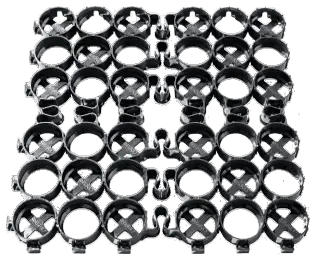
TRUEGRID PRO LITE permeable pavers are lightweight, DIY-friendly driveway and outdoor base pavers that install easily for a variety of projects. Made in the USA from 100%...
Does Self Binding Gravel Pass Permeable Surface Tests?
In the UK, front garden driveway surfaces are subject to permitted development restrictions that came into force in 2008. Under these rules, a new or replacement front garden driveway surface must be permeable, or must direct surface water to a permeable area such as a lawn, in order to avoid requiring planning permission.
Most self binding gravel products pass the permeable surface test used to assess compliance with these rules. The test involves pouring a defined volume of water onto the surface at a controlled rate and observing whether it infiltrates without ponding. A correctly installed self binding gravel surface on a free-draining sub-base will typically pass this test.
However, the outcome is product-dependent. A high-clay-content hoggin blend compacted to a dense finish may not achieve the same infiltration rate as a processed limestone or granite self binding gravel with a lower fines proportion. If planning compliance is a specific concern for your project, checking the permeability data for your chosen product with the supplier, or having the installed surface tested, is the most reliable approach.
For formal planning applications or assessments, the permeability characteristics of your surface should be documented using the test methodology specified by the relevant planning authority in your area.
What Happens to Drainage When Self Binding Gravel Is Laid Over Concrete or Tarmac?
Laying self binding gravel over an existing impermeable surface changes the drainage equation significantly. The self binding gravel layer itself retains its permeability, so surface water will pass through it. But it will then reach the impermeable concrete or tarmac below and have nowhere to go except along the falls of the underlying surface to the nearest outlet.
This means the existing drainage outlet, whether a gully, channel drain, or drainage fall to a permeable area such as a lawn or border, must be able to handle the drainage load. In most standard residential situations this is not a problem, because the self binding gravel layer actually reduces the peak flow to the outlet by absorbing and retaining a proportion of the rainfall in its void structure and releasing it more slowly than a bare impermeable surface would.
The specific installation considerations for laying self binding gravel over concrete or tarmac, including how to assess drainage adequacy before proceeding, are covered in the laying self binding gravel over concrete or tarmac guide.
Is Self Binding Gravel Porous?
Porosity and permeability are related but distinct properties. Porosity refers to the total void space within a material. Permeability refers to how well water can move through those voids. A material can be porous but have very low permeability if the voids are not interconnected.
Self binding gravel is both porous and permeable to a meaningful degree. The void structure within the compacted aggregate is interconnected, which allows water to move through it. The degree of permeability depends on the factors already described: fines content, compaction level, and product specification.
The term porous self binding gravel is sometimes used in product literature to distinguish products specifically formulated to maintain high permeability after compaction. These products typically have a lower fines content and a more open aggregate structure than standard self binding gravel. They perform well where sustainable drainage compliance is a primary requirement but may sacrifice some surface stability compared to a higher-fines product.
Does Self Binding Gravel Drain Well in Heavy Rain?
Under normal rainfall conditions, a correctly installed self binding gravel surface on an adequate sub-base drains effectively. The infiltration rate of most self binding gravel products comfortably exceeds average rainfall intensity in the UK and most of the US.
In extreme rainfall events, the infiltration capacity of any surface can be exceeded if the rainfall rate is higher than the rate at which water can move through the surface and sub-base layers. This produces temporary surface ponding that resolves as the rainfall rate drops. The same effect occurs on resin-bound permeable surfaces and open-graded aggregate surfaces under the most intense rainfall conditions. It is not specific to self binding gravel.
The most common scenario where drainage problems occur on self binding gravel installations is not extreme rainfall but inadequate sub-base drainage. If the sub-base material has become contaminated with fine soil particles over time, or if it was inadequately specified at installation, the drainage capacity of the base layer may be insufficient to handle the water transmitted through the self binding gravel surface. This causes the surface to remain wet for extended periods after rainfall and can lead to temporary softening of the surface layer.
Does Self Binding Gravel Allow Weeds to Grow Through It?
Permeability and weed growth are related concerns because both involve the passage of materials through the surface layer. Self binding gravel does not prevent weed growth in the way that an impermeable sealed surface does. Airborne weed seeds can establish on the surface of any aggregate material, and self binding gravel is no exception.
The geotextile membrane recommended beneath the sub-base prevents weed roots from growing upward through the formation and sub-base into the surface layer. This addresses the most persistent and damaging weed establishment route. Surface weeds establishing from airborne seed are a shallower problem and are managed by prompt removal before root systems become established in the bound layer.
Frequently Asked Questions
Is self binding gravel classed as a permeable surface for planning purposes? In most cases, yes. Most commercially available self binding gravel products, correctly installed on a permeable sub-base, are classified as permeable surfaces for planning purposes in the UK. However, this is product and installation dependent rather than guaranteed for all self binding gravel products. If planning compliance is critical for your project, verify the permeability characteristics of your chosen product with the supplier and check the specific requirements of your local planning authority.
Does self binding gravel get waterlogged? A correctly installed self binding gravel surface on a well-drained sub-base does not get waterlogged. Waterlogging occurs when water cannot drain from the surface and sub-base layers quickly enough. This is prevented by specifying an adequate sub-base depth and material, by ensuring the sub-base has positive drainage falls, and by keeping drainage outlets clear and functional.
Can I use self binding gravel near a soakaway? Yes. Self binding gravel is compatible with soakaway drainage systems. Surface water passing through the self binding gravel layer and sub-base can be directed to a soakaway without any technical incompatibility. The performance of the soakaway depends on the drainage capacity of the surrounding ground, which is a site-specific factor independent of the self binding gravel surface.
Will self binding gravel affect a nearby lawn or planting area? Self binding gravel does not release chemicals or substances that would damage adjacent lawn or planting. Water draining from a self binding gravel surface to a planted border or lawn is not chemically altered by passing through the aggregate. Limestone-based self binding gravel is mildly alkaline, and over time drainage from a limestone self binding gravel area into an adjacent planting bed may have a very minor effect on soil pH in that specific zone, but this is unlikely to be significant in practice for most plants.