
How Much Paver Sand Do I Need?
A paver installation requires two separate sand quantities: the bedding sand that goes beneath the pavers, and the jointing sand that fills the gaps between them after installation. Both need to be calculated and ordered before the project begins. Arriving on installation day with insufficient bedding sand is a project-stopping problem, and under-ordering jointing sand means a second purchase trip at the most inconvenient moment.
Bedding Sand Quantity
The bedding layer beneath pavers is a 1-inch uncompacted layer of mason sand or concrete sand, screeded flat across the full installation area before pavers are placed.
The reliable rule of thumb: approximately 100 pounds of sand per 10 square feet of patio area at a 1-inch depth.
The formula for precision: Length (ft) x Width (ft) x 0.083 (1 inch expressed as a fraction of a foot) = cubic feet. Divide cubic feet by 27 to get cubic yards. Multiply cubic yards by approximately 1.35 to get tons (mason sand weighs approximately 2,700 lb per cubic yard at typical moisture content).
Worked example: A 12-foot x 15-foot patio (180 square feet) at 1-inch bedding depth: 180 x 0.083 = 14.9 cubic feet. 14.9 / 27 = 0.55 cubic yards. 0.55 x 1.35 = 0.74 tons, or approximately 1,490 lb.
At 100 lb per 10 square feet, the same estimate gives 180/10 x 100 = 1,800 lb. The discrepancy reflects that the rule of thumb builds in a safety margin, which is appropriate — always order slightly more than the precise calculation suggests.
Quick-reference bedding sand table:
| Patio Area | Cubic Yards | Approx. Tons | Approx. 50 lb Bags |
|---|---|---|---|
| 50 sq ft | 0.15 | 0.21 | 8 |
| 100 sq ft | 0.31 | 0.42 | 17 |
| 200 sq ft | 0.62 | 0.83 | 34 |
| 300 sq ft | 0.93 | 1.25 | 51 |
| 400 sq ft | 1.23 | 1.66 | 67 |
| 500 sq ft | 1.54 | 2.08 | 83 |
Add 10 percent to the quantity from the table to account for wastage at edges, level variations, and any adjustments needed during installation.
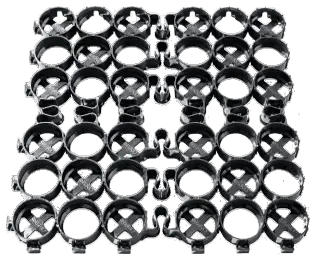
TRUEGRID PRO LITE permeable pavers are lightweight, DIY-friendly driveway and outdoor base pavers that install easily for a variety of projects. Made in the USA from 100%...
Jointing Sand Quantity
Jointing sand fills the gaps between pavers after they are installed and compacted. The quantity needed depends on the paver size, joint width, paver thickness, and total installation area.
Standard jointing sand estimate: For typical 4-inch x 8-inch concrete pavers with 1/8-inch joints and a 2.375-inch paver thickness, a standard estimate is approximately 25 to 30 pounds of jointing sand per 100 square feet of installed patio surface. For larger natural stone pavers with wider joints, this figure increases accordingly.
Polymeric jointing sand is sold in bags ranging from 40 to 50 pounds. For a 200-square-foot patio with standard concrete pavers, 2 to 3 bags of polymeric sand typically complete the jointing step.
Practical note on polymeric sand: Polymeric sand is sold by coverage area on the bag label. Use the manufacturer’s coverage figure, as it accounts for the specific paver type and joint width the product is designed for. Order one extra bag beyond the calculated quantity — having surplus polymeric sand is far less inconvenient than having to source more mid-job after the first pass has been swept in.
Bags vs Bulk: Which to Order
For patio areas under 150 square feet, bagged bedding sand from a home improvement store is the most practical option. The per-unit cost is higher than bulk, but the flexibility of being able to buy exactly the number of bags you need without delivery logistics outweighs the price premium at small quantities.
For patio areas above 200 square feet, bulk delivery from an aggregate supplier becomes the better value. At 200 square feet, a bulk delivery of 0.65 to 0.7 cubic yards can often be sourced for less than the equivalent bag quantity, particularly if delivery is combined with the compacted base material order.
The quantity calculation for the compacted crusher run or aggregate base layer that goes beneath the bedding sand is covered separately in our crusher run quantity guide, which gives the same formula and reference tables for the structural base.