
How to Use Sevin Dust Insecticide Powder Safely and Effectively
Sevin dust is one of the most widely available broad-spectrum insecticides in the home and garden market, and it is also one of the most frequently misapplied. The active ingredient is carbaryl, a carbamate-class insecticide that kills a wide range of pest insects on contact and through ingestion, but that is also highly toxic to honey bees, beneficial insects, and aquatic invertebrates. Using Sevin dust effectively means understanding not just how to apply it, but which situations genuinely warrant its use, which do not, and which restrictions must be respected on every application.
For complete product background including formulations, pest list, and active ingredient information, see the what is Sevin dust guide.
What Sevin Dust Contains and How It Works
Carbaryl is the active ingredient in Sevin dust formulations, typically at a concentration of 5% in the ready-to-use dust product. Carbaryl works by inhibiting acetylcholinesterase, the enzyme that clears the neurotransmitter acetylcholine from nerve synapses. When this enzyme is blocked, nerve signals fire continuously, causing paralysis and death. This same mechanism operates in any animal with a nervous system, which is why carbaryl has a broader toxicity profile than more selective insecticides.
Sevin dust has contact and stomach activity, meaning it kills insects both through direct skin contact and through ingestion when insects feed on treated plant surfaces. On plant surfaces in outdoor conditions, the residual activity of carbaryl is approximately one to two weeks, depending on rainfall, temperature, and sunlight exposure. Rain shortens the residual period and triggers the need for reapplication.
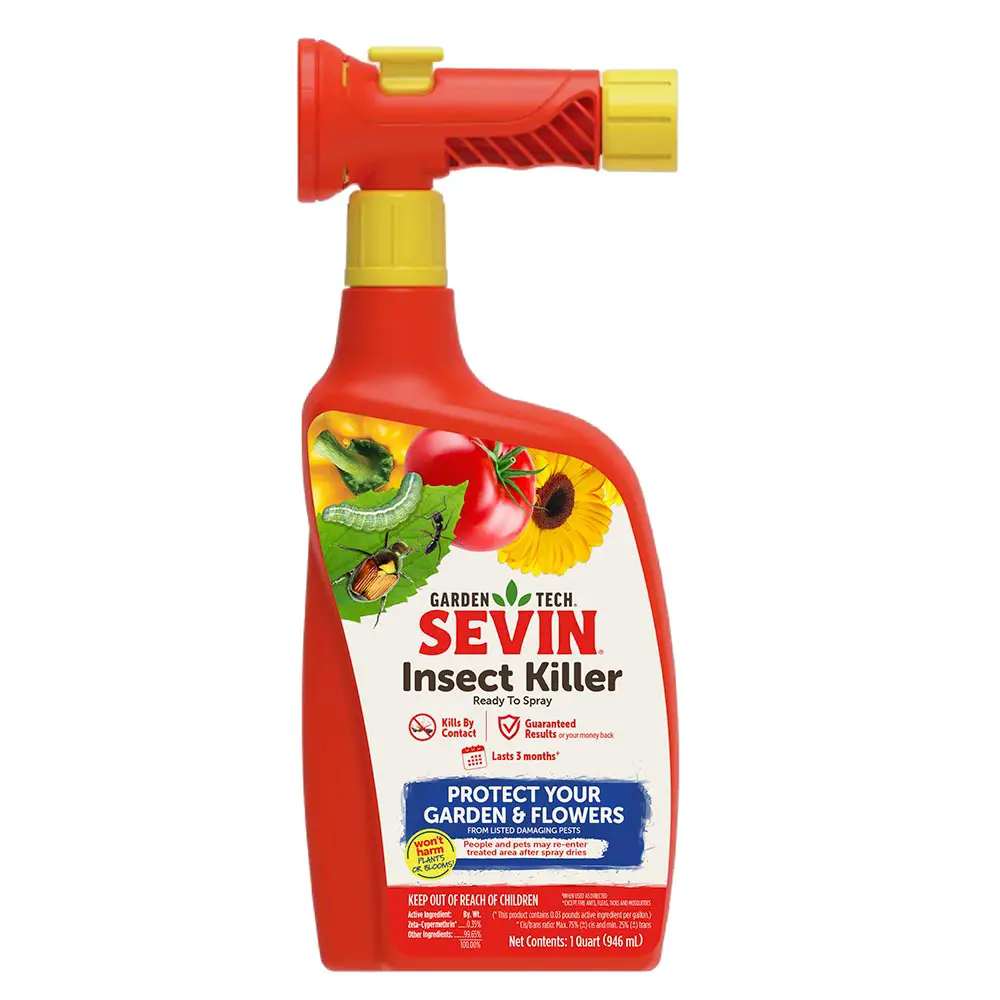
Sevin Insect Killer Ready to Spray helps protect flowers, vegetables, and ornamentals with a plant-safe formula that won’t harm blooms when used as directed. This hose-attachment spray targets a wide range of listed garden insects, including beetles, caterpillars, and aphids, for healthier plants. It provides up to 3 months of outdoor protection and lets people and pets return once the spray dries.
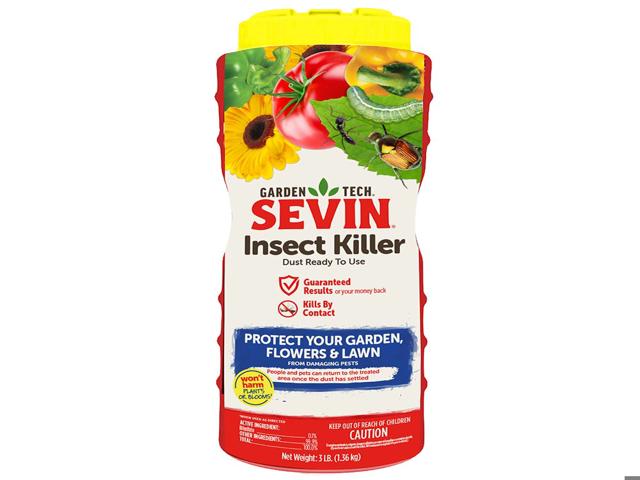
Sevin Insect Killer Dust helps protect flowers and lawn from listed damaging pests with a ready-to-use, shake-and-apply formula. It kills more than 150 insects by contact and creates a protective barrier when applied to leaves, stems, and flowers at the label rate. It won’t harm plants or blooms, and people and pets may return once the dust has settled.
When Sevin Dust Is Appropriate
Sevin dust is most appropriate for situations where a broad-spectrum contact insecticide is needed, where the target pest is not controlled effectively by organic alternatives, and where the treatment area can be restricted to avoid exposure to pollinators and aquatic environments.
Garden and lawn pest control
Specific situations where carbaryl is commonly used and registered include Japanese beetle adult control on ornamental plants, where the rapid knockdown and moderate residual prevent defoliation during peak beetle season. Squash bug control on cucurbits, caterpillar control on brassicas and tomatoes, aphid management on ornamentals, and flea and tick control in yard areas are all registered uses covered in more detail in the pest-specific guides linked at the end of this page.
Ground-nesting stinging insects
Sevin dust is particularly effective for treating yellow jacket and hornet nests in soil. The dust settles into and around the nest entrance tunnel, coating workers on every entry and exit. This application is covered in detail in the Sevin dust for yellow jackets guide, including the nighttime timing and protective clothing required.
Perimeter treatment around structures
Applying Sevin dust around the base of a home’s foundation, along fence lines, and at structural entry points creates a contact-kill barrier for crawling insects including ants, earwigs, pillbugs, and sowbugs. This perimeter application is one of the most common home uses of carbaryl dust.
When Sevin Dust Should Not Be Used
Sevin dust should not be applied in several situations, and recognizing these boundaries before applying is as important as knowing the correct method.
Near flowering plants during bloom
Carbaryl is highly toxic to honey bees and native pollinators on direct contact, and applying it to flowering plants during bloom creates a direct exposure pathway for foraging bees. This is the most critical restriction for home gardeners. Apply to vegetable crops before they flower or after flowers close for the day, and avoid treating ornamentals while they are in active bloom. The full discussion of carbaryl and pollinator risk is in the Sevin dust and bees guide.
Near water features
Carbaryl is highly toxic to aquatic invertebrates including shrimp, crayfish, and aquatic insects. Do not apply Sevin dust near ponds, streams, drainage channels, or any feature that drains to open water. Drift from outdoor applications can reach water bodies, and runoff from treated soil after rain is a pathway for aquatic contamination.
On unlisted crops or for unlisted pests
The product label lists every permitted crop and pest. Applying Sevin dust to a crop or for a pest not on the label is an illegal pesticide use in the United States. If the target crop or pest is not listed, consult the label for alternatives or contact your local cooperative extension office for registered options.
Indoors as a primary treatment
Sevin dust is formulated for outdoor use. It is not an effective or appropriate treatment for indoor insect infestations, with the exception of some limited perimeter and entry-point applications covered in older label versions. Products formulated specifically for indoor use are appropriate for indoor pest problems.
How to Apply Sevin Dust
Equipment
Sevin 5 Dust is sold in a shaker canister that allows direct application without additional equipment. A hand duster or squeeze-bottle applicator provides more precise placement and is useful for directing dust into nest entrances, cracks, and specific plant surfaces without broadcasting excess product. For large lawn areas, a rotary or drop spreader is not appropriate for fine dust formulations.
Application method
Apply a thin, even coating of dust to the target surface. A light dusting that visibly covers the plant surface or soil is sufficient. Heavy deposits do not improve pest control and increase environmental exposure unnecessarily. Apply thin is the correct approach: concentrate the dust on the surfaces where pests contact or feed, such as leaf undersides, stem bases, and soil around plant crowns, rather than smothering the entire plant.
For garden and lawn use, hold the shaker canister or duster close to the target surface to minimize airborne drift. Wearing a dust mask during application prevents inhalation of the fine carbaryl particles.
Timing
Early morning and evening are the best times to apply Sevin dust outdoors. Bee foraging activity peaks in mid-morning to early afternoon on warm days. Applying before bees become active or after they have returned to nests for the evening substantially reduces the probability of pollinator contact with fresh carbaryl residues.
Do not apply when wind speeds make dust drift unavoidable. Apply when foliage is dry, as wet leaves cause dust to clump and distribute unevenly.
After application
Keep people, children, and pets away from the treated area until the dust has settled and the surface is dry. Wash hands thoroughly after handling the product and before eating, drinking, or touching the face. Do not water the treated area for at least 24 hours after application, as irrigation washes carbaryl from plant surfaces and into the soil before the residual has been established. The full safety information for people and pets is in the is Sevin dust harmful to humans and is Sevin dust safe for dogs and pets guides.
Re-Entry and Pre-Harvest Intervals
The re-entry interval is the minimum time that must pass before people and pets return to a treated area. This interval varies by crop and application site and is stated on the product label for each permitted use. The label is the legal standard and supersedes any general guidance.
The pre-harvest interval (PHI) is the number of days that must pass between the last application of Sevin dust and the harvest of edible portions of a treated crop. Carbaryl breaks down over this period to concentrations the EPA considers acceptable for human consumption. Common PHI values for vegetables include 3 days for tomatoes, peppers, and cucurbits, 7 days for potatoes, and longer intervals for leafy greens. The full pre-harvest interval information for vegetable crops, along with guidance on washing produce after treatment, is in the Sevin dust in the vegetable garden guide.
For fruit trees, PHI values vary by species and are listed individually on the label. Always consult the label in hand, as PHI values can change between label revisions.
How Often to Apply Sevin Dust
Carbaryl residual activity lasts one to two weeks under normal outdoor conditions. Reapplication every 7 to 14 days during active pest pressure maintains continuous control in treated areas. Heavy rainfall within 24 hours of application washes carbaryl from plant surfaces and may require earlier reapplication.
Do not apply more frequently than the label allows for any specific crop. The label specifies a maximum number of applications per season for each crop, and this limit exists to prevent carbaryl residue accumulation above safe levels at harvest.
Resistance and Rotation
Carbaryl is a carbamate insecticide with a specific mode of action (Group 1A). Continuous use of any single mode of action can select for resistant pest populations over time. Rotating carbaryl with insecticides from different mode-of-action groups reduces resistance pressure. Pyrethroids (Group 3A), spinosad (Group 5), and neem oil (Mode 18) are common rotation partners for vegetable garden use. A practical comparison of carbaryl versus non-chemical alternatives is in the Sevin dust vs diatomaceous earth guide.
Pest-Specific Application Guides
The step-by-step information on this page covers general application. Pest-specific timing, rates, and methods for the highest-volume Sevin dust uses are covered in dedicated guides:
Flea and tick yard treatment is in the Sevin dust for fleas and ticks guide. Ant control including fire ants and carpenter ants is in the Sevin dust for ants guide. Yellow jacket and wasp nest treatment is in the Sevin dust for yellow jackets guide. Backyard flock treatment for mites and lice is in the Sevin dust for chickens guide. Safety information for dogs, cats, and people is in the is Sevin dust safe for dogs and pets and is Sevin dust harmful to humans guides.